
TL;DR:
- Multilingual support is essential for European startups to build trust and expand quickly across markets.
- Eastern Europe offers cost-effective, culturally aligned, and EU-compliant call center options for support.
- Human-AI hybrid models and structured pilots reduce risks and improve support quality during scaling.
Scaling internationally sounds exciting until your customer support falls apart in three different languages simultaneously. Many European startups assume that world-class multilingual call center support belongs only to enterprise players with massive budgets. That assumption is wrong, and it costs early-stage companies real market share. The truth is that smart outsourcing strategies, paired with the right regional partners and technology, make high-quality multilingual support accessible at any stage. This guide walks you through the precise steps to evaluate, launch, and optimize a multilingual call center setup that grows with your startup.
Table of Contents
- Why multilingual call centers matter for European startups
- Choosing the right region and partner: Why Eastern Europe leads
- Human-AI hybrid strategies: Building cost-effective, reliable support
- Trial periods and pilot programs: Minimizing risk and ensuring fit
- Why startups shouldn’t settle: Going beyond basic call center outsourcing
- How to scale your startup’s support with the right partner
- Frequently asked questions
Key Takeaways
| Point | Details |
|---|---|
| Multilingual support is strategic | European startups need culturally aware, multilingual call centers to scale and retain customers internationally. |
| Eastern Europe is ideal | Providers in Romania and Poland offer affordable, compliant, and highly skilled support for startups. |
| Hybrid human-AI works best | Blending technology and expert agents covers edge cases, language switches, and emotional scenarios. |
| Pilots de-risk your choice | Short trial periods help validate provider fit, compliance, and customer satisfaction before full rollout. |
Why multilingual call centers matter for European startups
European expansion is not a single market challenge. It is a mosaic of languages, cultural expectations, legal frameworks, and consumer behaviors. A startup that launches in Germany, Spain, and Poland simultaneously faces three entirely different customer relationship dynamics. Handling that with a single English-speaking support team is not a scaling strategy. It is a churn accelerator.
The urgency here is real. Cultural nuances and compliance challenges require human-AI hybrid solutions, and agent attrition in the industry averages around 40%. That number matters because high turnover directly degrades the consistency of service customers experience, especially when those customers already sense they are talking to someone unfamiliar with their culture or language.
For scaling startups, the risks of poor multilingual support compound quickly. A Spanish customer who struggles to explain a billing issue in broken English to an undertrained agent does not stay a customer long. That same frustration, multiplied across hundreds of interactions in markets you are trying to break into, creates a reputational problem that no marketing budget can fully fix.
Here is what strong outsourcing call center services actually provide for growth-stage companies:
- Native-language fluency that makes customers feel genuinely understood, not just technically assisted
- Cultural alignment that shapes how agents handle conflict, express empathy, and set expectations
- Regulatory compliance across GDPR and local consumer protection laws in each market
- Faster market fit because accurate, localized support accelerates trust-building
- Higher CSAT scores that translate directly into retention and word-of-mouth referrals
- Reduced escalation volume when agents understand the cultural context behind a complaint
Understanding why multilingual support matters goes beyond linguistics. A German customer expects precision and process clarity. A Romanian customer may prioritize warmth and relationship. An Italian customer might frame urgency differently than a Finnish one. These are not stereotypes. They are learned communication patterns that trained, regionally aware agents navigate daily.
“Startups that localize support from day one grow their Net Promoter Scores in new markets up to 25% faster than those who bolt on multilingual support as an afterthought.” This pattern repeats across SaaS and e-commerce verticals alike.
Treating multilingual customer support as a core growth lever, rather than a back-office cost, is what separates startups that achieve fast market penetration from those that stall after initial traction.
Choosing the right region and partner: Why Eastern Europe leads
Knowing the value of multilingual call centers, the next question is where to find the best partners to meet demanding European standards.
Not all outsourcing regions are equal. While South Asia and Southeast Asia offer cost advantages, they often struggle with the specific language pools and cultural proximity that European startups need. Eastern Europe stands apart. Countries like Romania, Poland, Hungary, and Bulgaria produce large numbers of university-educated, multilingual professionals who speak fluent English plus two or three additional European languages.
Eastern European providers like those in Romania and Poland offer cost-effective, multilingual talent and strong EU compliance, making them a natural fit for startups that need to move fast without sacrificing quality or legal standing.
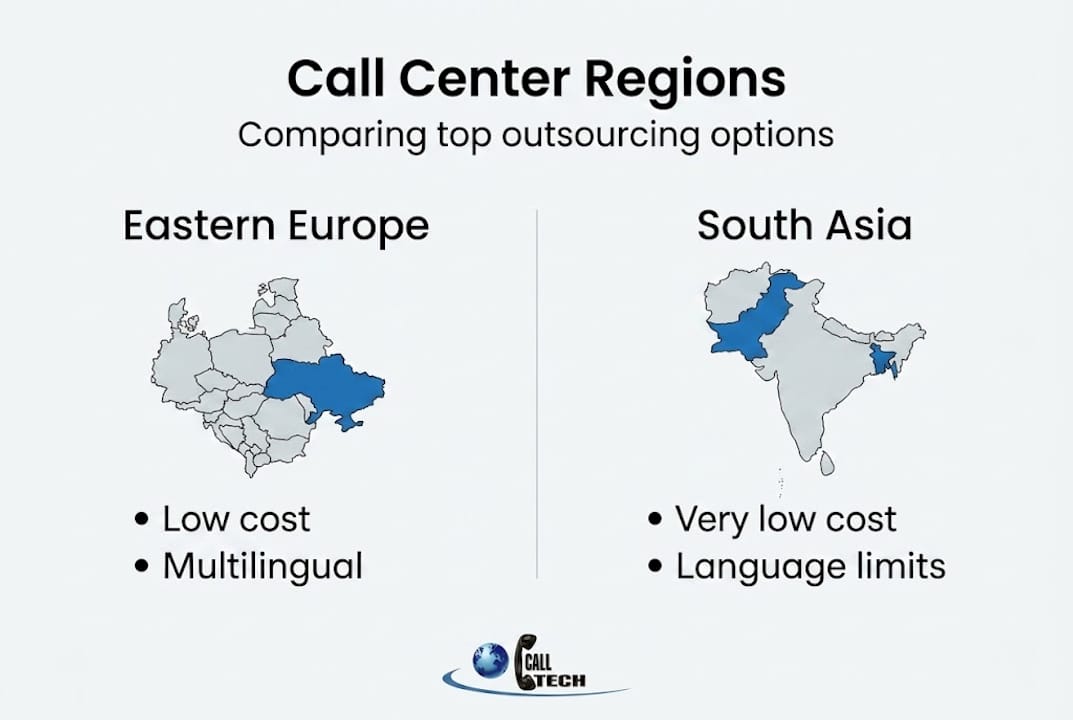
Here is a direct comparison of what regional options look like for European startups:
| Factor | Eastern Europe | Western Europe | South Asia |
|---|---|---|---|
| Cost per agent (monthly) | Low to medium | High | Very low |
| EU compliance familiarity | Very high | Very high | Low |
| European language coverage | Broad (15+ languages) | Broad but expensive | Limited |
| Cultural fit for EU customers | Strong | Strong | Moderate |
| Talent pool scalability | Large | Limited | Very large |
| Average agent retention | Medium to high | High | Low to medium |
The outsourcing advantages in Eastern Europe are not just about lower wages. Eastern European agents bring a combination of formal education, EU regulatory awareness, and genuine cultural overlap with customers across the continent. That is a combination you rarely find in other regions at the same price point.
Key regional strengths worth prioritizing in your partner search:
- Large pools of certified bilingual and trilingual agents
- Built-in familiarity with GDPR and EU consumer rights frameworks
- Time zone alignment with Western and Northern European markets
- Lower wage inflation compared to Western European providers
- Strong track record with SaaS, telecom, and digital service verticals
When evaluating best call center services in this region, look beyond sales decks. Ask for live demonstrations, reference clients in your industry, and agent profiles across the specific languages you need covered.
Pro Tip: Before signing any long-term contract, negotiate a structured trial period of 14 to 30 days. Run real customer interactions through the system. A short pilot costs a fraction of the risk of committing to a 12-month agreement with a partner who cannot deliver in your target language and at your quality bar.
Human-AI hybrid strategies: Building cost-effective, reliable support
Once you’ve narrowed down regional options, it’s vital to understand how technology and human expertise must work together for scalable support.

Artificial intelligence has genuinely transformed what call centers can handle. Chatbots manage routine queries at scale. Automated systems handle password resets, order status checks, and basic billing lookups without any human involvement. For startups watching unit economics closely, that matters. But the boundary of AI competence in customer service has not moved as far as vendors often claim.
Edge cases and mid-conversation language switches require hybrid approaches, and AI accuracy in real-world customer experience contexts sits between 70 and 80%. That remaining 20 to 30% represents emotionally charged complaints, ambiguous requests, regulatory nuance, and exactly the situations where a poor response damages your brand most. Leaving those moments to automation alone is a strategic error.
Here is how human, AI, and hybrid capabilities map across common startup call scenarios:
| Scenario | AI only | Human only | Hybrid (recommended) |
|---|---|---|---|
| Order status, FAQ | Excellent | Overkill | Good |
| Billing dispute | Poor | Good | Excellent |
| Technical escalation | Poor | Good | Excellent |
| Language switch mid-call | Very poor | Good | Excellent |
| Emotional complaints | Very poor | Excellent | Excellent |
| Onboarding new customers | Moderate | Good | Excellent |
Building a cost-effective hybrid model for your startup follows a logical sequence:
- Map your query volume by type. Identify which contact categories are routine, which are sensitive, and which require regulatory knowledge. This segmentation guides where AI earns its place.
- Automate the repeatable. Deploy AI-driven chat and voice assistants for high-volume, low-complexity queries. Set clear escalation triggers before you go live.
- Train agents on escalation protocols. When AI hands off to a human, the transition must feel seamless to the customer. Clunky handoffs destroy the experience the AI saved.
- Set language-specific routing rules. Ensure that calls flagged for escalation route automatically to agents certified in the customer’s native language, not just the closest available agent.
- Review AI accuracy monthly. Track misrouted calls, repeat contacts, and customer satisfaction scores by channel. AI systems need ongoing tuning as your product and market evolve.
Best practices for efficiency consistently show that hybrid models reduce average handle time while maintaining or improving customer satisfaction scores. The key is treating AI as an augmentation layer, not a replacement for human judgment.
AI in customer service is advancing rapidly, including in authentication and security workflows. But the strongest use cases pair machine speed with human contextual awareness, not one at the expense of the other.
Pro Tip: Listen to call recordings from your first 30 days of operation and tag every instance where a customer expressed frustration or repeated themselves. These moments reveal exactly where your AI boundaries should sit and where human agents must take over.
Trial periods and pilot programs: Minimizing risk and ensuring fit
Ensuring reliability doesn’t stop with choosing a provider or technology mix. The final test is how well the relationship works for your unique needs.
Pilots exist for a reason. No sales presentation, reference call, or case study can fully simulate the experience of your actual customers interacting with a new support team in real conditions. A well-structured pilot period gives you live data, not projections. It surfaces problems while they are still cheap to fix rather than after your brand reputation has been damaged in a new market.
Starting with pilots like 14-day trials allows startups to evaluate cultural alignment and service quality before committing to extended agreements. Companies that run structured pilots consistently report faster onboarding and fewer contract disputes.
During a pilot, these are the metrics that actually tell you whether a provider can deliver:
- First contact resolution rate across each language supported
- Average response time broken down by channel and language
- Escalation rate and how cleanly agents handle handoffs
- Customer satisfaction scores from actual post-interaction surveys
- Compliance adherence for any data handling, scripting, or disclosure requirements in your markets
- Agent consistency across different shifts and days, not just peak performance moments
“One e-commerce startup running a 14-day pilot discovered that their provider’s Polish-language team outperformed their English-language team on customer satisfaction by 18 percentage points, directly informing their regional hiring and expansion decisions.”
That kind of insight is unavailable without a real pilot. Assumptions based on agent certifications or language test results alone are insufficient.
Shared call center pilots offer startups a particularly flexible entry point. In shared models, you access trained multilingual agents without bearing the full cost of a dedicated team. This structure lets you run meaningful pilots at controlled cost while still generating representative data.
Customer service pilot examples from adjacent industries show that the most useful pilots include edge case simulation, not just standard interaction monitoring. Ask your provider to handle a deliberately complex billing dispute or a frustrated customer scenario in each target language during the trial.
Pro Tip: Assign one internal team member as the sole point of contact for the pilot period. Their job is to document every friction point, review recordings daily, and submit structured feedback to the provider weekly. Structured feedback loops dramatically accelerate what you learn during a short trial.
Why startups shouldn’t settle: Going beyond basic call center outsourcing
Here is an uncomfortable observation from working with growth-stage companies across Europe: the startups that struggle with customer support internationally almost always made the same mistake. They chose their call center partner based primarily on price.
That decision looks rational on a spreadsheet. It rarely looks rational six months later when churn is climbing in a market you invested heavily to enter, and you cannot identify why. The answer, more often than not, is a provider who could technically handle calls in the target language but lacked the cultural awareness, QA discipline, and agent retention that genuine quality requires.
The common outsourcing mistakes European companies make follow a recognizable pattern. A startup picks a low-cost provider, skips the pilot, and discovers quality problems only after they are visible to customers. By then, the reputation damage is already being indexed on review platforms.
What the fast-scaling startups do differently is treat their call center partner the way they treat a product hire: with a structured evaluation, a clear performance framework, and a willingness to invest in the relationship rather than just the transaction. They run pilots. They measure cultural alignment explicitly. They push back on attrition numbers and ask how providers protect institutional knowledge when agents leave.
Technology is not the answer to this problem. A polished AI-driven interface backed by culturally misaligned agents still produces frustrated customers. The persistent myth that automation can fully substitute for trained, culturally aware agents is expensive for the startups that believe it. The reality is that your best competitive advantage in a new European market is often a customer support experience that feels local. That requires real people, real training, and real regional expertise.
How to scale your startup’s support with the right partner
With a clear understanding of your options and best practices, the final step is putting these insights into action for your own startup.
At CallTech Outsourcing, we have spent nearly 20 years building exactly this kind of multilingual support infrastructure for companies at every growth stage. Our teams cover more than 15 European languages, operate within EU compliance frameworks, and integrate directly with your CRM and communication systems.

Whether you are entering your first new European market or managing support across six countries simultaneously, our outsourcing call center services are designed to scale with you, not against you. We offer flexible entry points including pilot programs, shared agent models, and dedicated team structures depending on your volume and growth stage. Explore our multilingual engagement solutions to see how we match language coverage, cultural expertise, and technology to your specific market needs.
Frequently asked questions
How do startups measure if a call center is truly multilingual?
Look for proven support across your customers’ target languages by requesting pilot results with live conversations in each language, since cultural sensitivities and mid-conversation switches present real challenges that advertised language lists cannot capture.
What is a realistic agent attrition rate for outsourced call centers?
A typical agent attrition rate sits around 40%, so always ask providers for their specific retention records and how they maintain service consistency when agents leave.
Why do startups in Europe prefer Eastern European call centers?
Eastern European centers in countries like Romania and Poland offer cost-effective, multilingual staff with strong EU compliance familiarity and close cultural proximity to European customer expectations.
When is a human-AI hybrid better than pure automation?
Hybrid models outperform automation in situations involving emotional complaints, complex disputes, or any scenario requiring a mid-call language switch, where AI accuracy alone is insufficient.
What should you test in a call center pilot for your startup?
Test multilingual accuracy, compliance adherence, agent responsiveness, and real customer satisfaction scores on live interactions, since pilots like 14-day trials reveal alignment gaps that no pre-sales evaluation can surface.
