
TL;DR:
- Cloud contact centers enable rapid, cost-effective, multilingual support deployment globally.
- They offer significant savings, scalability, and easier integration with existing business systems.
- Success depends on combining technology with effective agent training and change management.
Many companies assume that running powerful, multilingual customer support across multiple countries requires massive server rooms, six-figure hardware budgets, and months of painful setup. That assumption is wrong, and it’s costing businesses real money. Cloud-based contact centers have flipped the traditional model entirely, letting you deploy a fully operational, multilingual support operation in days rather than months. The cost savings are dramatic, the flexibility is real, and the technology is mature enough to handle enterprise-scale demand. This guide breaks down exactly what these platforms offer, where they shine, and where you need to be careful.
Table of Contents
- What are cloud-based contact centers?
- Cost and operational benefits for global support
- AI, automation, and edge-case challenges
- Selecting the right platform for your business
- A fresh perspective: What leaders overlook about cloud contact centers
- Take your global support to the next level
- Frequently asked questions
Key Takeaways
| Point | Details |
|---|---|
| Major cost savings | Switching to cloud-based contact centers reduces infrastructure costs by over 50%. |
| Rapid global deployment | Cloud platforms enable fast startup times and seamless expansion for international support. |
| AI and human synergy | Combining automation with skilled multilingual agents delivers optimal service quality. |
| Smart platform selection | Choosing the right cloud provider ensures scalability, integration, and multilingual capabilities. |
What are cloud-based contact centers?
A cloud-based contact center is a customer support platform hosted on remote servers and delivered over the internet, rather than running on hardware installed at your office or data center. Your agents can log in from anywhere. Your infrastructure scales up or down based on demand. You pay for what you use, not for capacity that sits idle during off-peak hours.
This is fundamentally different from traditional on-premise setups. With legacy systems, you buy the hardware, hire the IT staff to maintain it, and absorb every upgrade cost yourself. With cloud platforms, the vendor handles infrastructure, security patches, and uptime. Your team focuses on customers, not servers.
Here’s what separates cloud contact centers from their on-premise counterparts:
- Deployment speed: Cloud systems go live in days. On-premise builds take months.
- Cost model: Cloud runs on operating expenses (OpEx), not large capital expenditures (CapEx).
- Accessibility: Agents work from any location with a stable internet connection.
- Scalability: Add seats or languages in hours, not weeks.
- Maintenance: Vendor-managed updates, no internal IT burden.
| Feature | Cloud-based | On-premise |
|---|---|---|
| Upfront cost | Low | High |
| Deployment time | Days | Months |
| Scalability | Instant | Slow and costly |
| Maintenance | Vendor-managed | Internal IT team |
| Multilingual support | Built-in routing | Custom development |
| Remote agent access | Native | Requires VPN setup |
For companies expanding into European or global markets, cloud contact center platforms offer something on-premise systems simply cannot match: the ability to add language support and regional capacity without rebuilding your infrastructure from scratch.
“The shift to cloud is not just a technology upgrade. It is a business model change that removes the ceiling on how fast you can grow your support operations.”
Modern platforms also integrate directly with CRM tools, ticketing systems, and analytics dashboards. This means your support data flows into the same systems your sales and product teams already use. For SaaS customer support platforms, this kind of native integration is often the deciding factor when evaluating vendors. The best contact center services in 2026 are built around this connected, data-driven model.
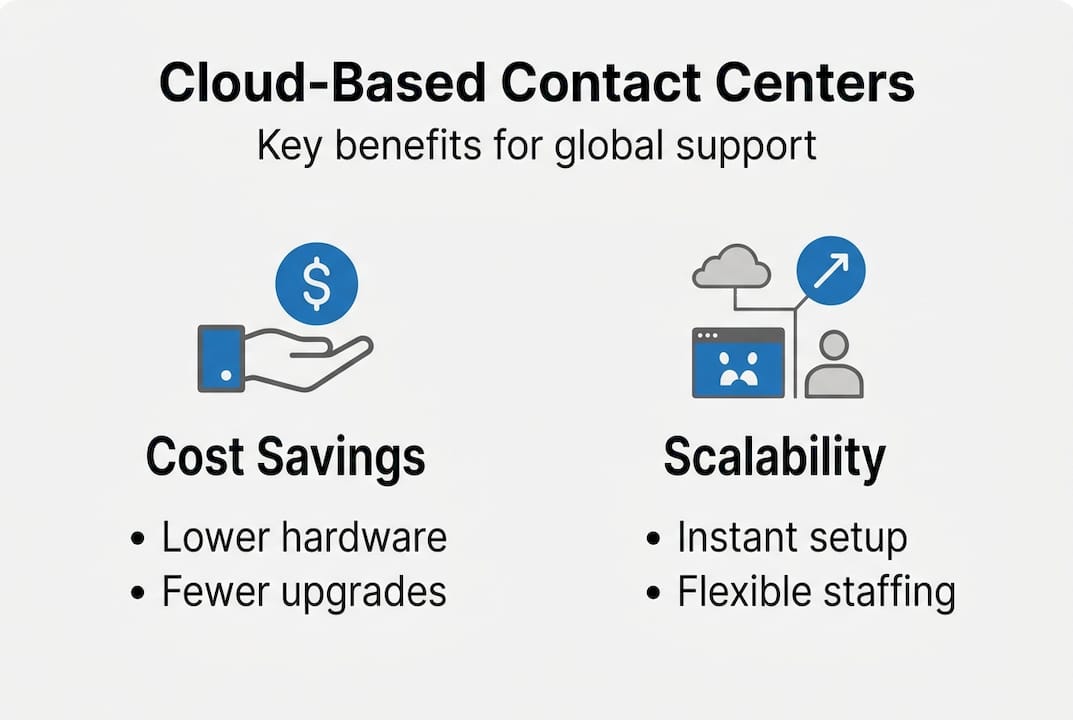
Cloud deployment also delivers 50% or more in infrastructure cost savings compared to on-premise builds, with activation measured in days rather than months. For any business planning international expansion, that speed and cost profile changes the entire growth equation.
Cost and operational benefits for global support
Let’s move from definition to dollars. The financial case for cloud-based contact centers is not subtle. When Accenture Brazil migrated its contact center operations to a cloud platform, the results were striking: 50% infrastructure cost reduction, 25,000 multilingual calls handled per month, 35% less downtime, and 50% faster agent training. These are not theoretical projections. They are documented operational outcomes.
Here is where the savings actually come from:
- No hardware purchases: Eliminate server racks, telephony equipment, and data center leases.
- Reduced IT overhead: Vendor-managed infrastructure means fewer internal engineers needed.
- Pay-as-you-scale pricing: Add capacity only when you need it, and remove it when you don’t.
- Faster agent onboarding: Cloud-based training tools cut ramp-up time significantly.
- Lower downtime costs: Redundant cloud architecture reduces service interruptions.
| Cost category | On-premise (annual estimate) | Cloud-based (annual estimate) |
|---|---|---|
| Hardware and servers | $80,000+ | $0 |
| IT maintenance staff | $60,000+ | Minimal |
| Downtime losses | High | 35% lower |
| Agent training time | Weeks | Days |
| Scaling cost | High CapEx | Low OpEx |
For companies managing multilingual support across several European markets, the operational math gets even more favorable. Adding a new language on a cloud platform typically means routing configuration and agent assignment, not a new hardware deployment. That agility is worth real money when you are racing a competitor to a new market.
The scalability factor also matters for seasonal businesses and e-commerce companies. You can surge capacity during peak periods and scale back during slower months, paying only for what you actually use. This is something outsourcing administrative services providers have built entire service models around, because the demand is real and consistent.

Pro Tip: Use your cloud platform’s built-in analytics to track agent utilization rates by language and time zone. This data lets you optimize staffing schedules and reduce idle time, which directly lowers your cost per contact. Most businesses leave this lever untouched for months after deployment.
For companies evaluating offshore call center cost savings, combining cloud infrastructure with strategically located multilingual teams creates a compounding cost advantage that neither approach achieves alone.
AI, automation, and edge-case challenges
AI is now a standard feature in cloud contact centers, not a premium add-on. Chatbots handle first-contact resolution for routine inquiries. Intelligent routing sends callers to the right agent based on language, issue type, and customer history. Sentiment analysis flags at-risk customers in real time. These tools genuinely reduce handle times and free your human agents for complex, high-value interactions.
But the honest picture includes real limitations. AI can struggle with regional accents, noisy call environments, complex emotional states, and regulatory data privacy requirements. A customer calling from a rural area with a strong regional dialect may get misrouted or misunderstood by an automated system. A caller in distress may need a human response that no algorithm can replicate. These are not edge cases you can ignore when your brand reputation is on the line.
Here is where AI performs well and where it falls short:
- Strengths: Routine FAQs, appointment scheduling, order status, password resets, basic billing queries.
- Weaknesses: Accented speech recognition, emotionally charged calls, multi-step compliance workflows, nuanced complaints.
- Risk areas: Data privacy regulations (GDPR, for example) require careful configuration to avoid compliance violations.
- Mitigation: Build clear human handover triggers so agents take over before AI failures damage the customer relationship.
“The goal is not to replace human judgment with automation. The goal is to use automation to protect human agents’ time for the moments where human judgment is irreplaceable.”
For companies running multilingual call center processes, this balance is especially critical. A French-speaking customer in Belgium and a French-speaking customer in Senegal may use the same language but have very different accents, expectations, and cultural communication styles. AI trained on one population may underperform with the other.
The solution is a hybrid model. Use AI to handle volume and speed. Use multilingual human agents for complexity and emotional intelligence. Platforms that support optimizing global contact center workflow make this handover seamless when configured correctly. And if you are evaluating outsourcing contact center services, look for partners who already have this hybrid model built into their delivery methodology.
Pro Tip: Combine AI tools with native-speaking human agents for your top three customer languages by volume. This single decision typically captures 80% of the quality improvement while keeping costs manageable.
Selecting the right platform for your business
Choosing a cloud contact center platform is not a purely technical decision. It is a strategic one. The wrong platform locks you into workflows that don’t match your growth plans. The right one becomes a genuine competitive advantage. Here is a structured way to evaluate your options.
- Reliability and uptime guarantees: Look for 99.9% or higher SLA commitments. Downtime in a contact center is not an abstract metric. It is unanswered customer calls and lost revenue.
- Multilingual routing and language detection: The platform should automatically detect customer language and route to the appropriate agent pool without manual intervention.
- CRM and tool integration: Native connectors to Salesforce, HubSpot, Zendesk, or your existing ticketing system are non-negotiable for a unified customer view.
- Compliance and data security: Especially for European markets, GDPR compliance must be built into the platform, not bolted on afterward.
- Scalability architecture: Confirm the platform can handle your projected peak volume, not just your current average.
- Reporting and analytics depth: Real-time dashboards and historical reporting should cover agent performance, language-specific metrics, and customer satisfaction scores.
For multilingual operations specifically, prioritize platforms with native speaker agent support, not just translation overlays. There is a significant quality difference between a platform that routes a Spanish call to a Spanish-speaking agent and one that routes it to an English-speaking agent with a translation tool.
Platforms built for scalable support outsourcing methods typically include these multilingual capabilities as core features. Cloud contact centers offer rapid deployment, scalable global support, and advanced analytics designed specifically for multilingual demand at scale.
Pro Tip: Before signing any contract, run a remote agent onboarding simulation. Ask the vendor to walk you through how a new agent in a different country gets set up and trained on the platform. This single test reveals more about real-world usability than any feature checklist.
Also evaluate the vendor’s support model. A platform that goes down at 2 a.m. on a Saturday needs a vendor with 24/7 technical support, not a ticket queue that gets answered Monday morning.
A fresh perspective: What leaders overlook about cloud contact centers
Most decision-makers evaluate cloud contact centers through a cost lens. They run the numbers, confirm the savings, and sign the contract. Then they wonder six months later why customer satisfaction scores haven’t moved.
Here is the uncomfortable reality: technology is the easy part. The hard part is cultural readiness and agent empowerment. A cloud platform does not automatically make your support team better. It gives them better tools. Whether those tools translate into better customer experiences depends entirely on how well you prepare your people and manage the change.
We have seen this pattern consistently. Companies invest in the platform, skip the change management, and then blame the technology when results disappoint. The real failure is usually a mismatch between the platform’s capabilities and the team’s ability to use them effectively.
Cloud solutions succeed when they are paired with strategic investment in multilingual staffing quality and genuine agent training, not just technical onboarding. Align your technology choices with specific business outcomes: first-contact resolution rates, customer satisfaction scores, and language-specific performance benchmarks. Efficiency without customer satisfaction is just fast failure.
Take your global support to the next level
If you have been running customer support on aging infrastructure or managing multilingual demand with patchwork solutions, the gap between where you are and where cloud-based operations can take you is significant.

At CallTech Outsourcing, we have spent nearly 20 years helping telecom, SaaS, and e-commerce companies build scalable multilingual support operations that actually perform. Our multilingual outsourcing services are designed to integrate with your existing systems and grow with your business across more than 15 European languages. Whether you need to optimize your global contact center workflow or build a new multilingual support function from scratch, we can help you move faster and smarter than going it alone.
Frequently asked questions
How much can companies save by switching to a cloud-based contact center?
Companies typically achieve 50% or more in infrastructure savings compared to traditional on-premise setups, with additional savings from reduced IT staffing and faster agent onboarding.
What are the risks of using AI in cloud contact centers?
AI can struggle with accents, noisy call environments, and complex emotional contexts, so human agents should always be available as a handover option for challenging situations.
How quickly can a cloud-based contact center be deployed?
Cloud-based contact centers can go live in days rather than months, which is a critical advantage for companies entering new markets or scaling rapidly.
Does cloud-based contact center technology support multilingual agents?
Yes, these platforms are built to detect customer language automatically and route calls to the right agent pool, enabling teams to handle 25,000 multilingual calls per month at scale.
