
Many global business leaders assume that matching customer support agents to customer cultures guarantees satisfaction. This belief oversimplifies a complex reality. True cultural sensitivity in customer service requires strategic awareness, deliberate adaptation, and systematic methodologies that go far beyond superficial cultural matching. Companies expanding into international markets need frameworks that build genuine cultural intelligence across their support teams. This guide explains the core concepts, empirical evidence, and practical steps that help business leaders implement culturally sensitive customer service strategies that drive measurable improvements in customer satisfaction, retention, and revenue across diverse global markets.
Table of Contents
- Key takeaways
- Understanding cultural sensitivity in customer service
- Methodologies to build cultural sensitivity in customer support teams
- Practical mechanics for adapting support to cultural differences
- Navigating challenges and measuring success in culturally sensitive service
- Enhance your global customer service with CallTech
- Frequently asked questions
Key Takeaways
| Point | Details |
|---|---|
| Strategic adaptation over matching | True cultural sensitivity requires deliberate adaptation and systematic methodologies beyond superficial cultural matching to improve satisfaction and revenue. |
| Cultural intelligence training | Structured CQ frameworks and experiential simulations boost agents’ cultural competence and sustain behavior change with blended learning. |
| Multilingual native agents | Utilizing multilingual native agents and ongoing language personalization improves support outcomes across diverse markets. |
| Adjusted bias benchmarking | Satisfaction scores must be adjusted for cultural biases to avoid misrepresenting performance across regions. |
| Reputation and revenue risk | Failure to adapt culturally can damage brand reputation and cause revenue losses in international markets. |
Understanding cultural sensitivity in customer service
Cultural sensitivity in customer service is the awareness, understanding, and adaptation to cultural differences in communication styles, expectations, and preferences to provide respectful and effective support in global markets. This definition encompasses three critical components that business leaders must recognize when building international customer support operations.
The first component is awareness. Support teams must recognize that cultural differences exist and influence customer interactions. The second is understanding, which involves learning specific cultural norms, values, and communication preferences that shape customer expectations. The third component is adaptation, the practical application of cultural knowledge to modify support approaches for different markets.
Cultural sensitivity directly impacts how customers perceive service quality across diverse markets. Communication styles vary dramatically between cultures. Some markets prefer direct, transactional interactions while others expect relationship building before business discussions. Customer expectations around response time, formality, and problem resolution differ significantly across regions. Preferences for communication channels, tone, and even complaint expression follow cultural patterns that support teams must navigate skillfully.
For global business leaders, cultural sensitivity represents a competitive advantage in international markets. Companies that invest in culturally aware support operations see higher customer satisfaction, improved retention rates, and stronger brand reputation across diverse regions. Outsourcing call center services to providers with multilingual, culturally trained teams allows businesses to scale these capabilities efficiently.
Cultural sensitivity transforms customer service from a cost center into a strategic asset that drives global market success through authentic, respectful customer relationships.
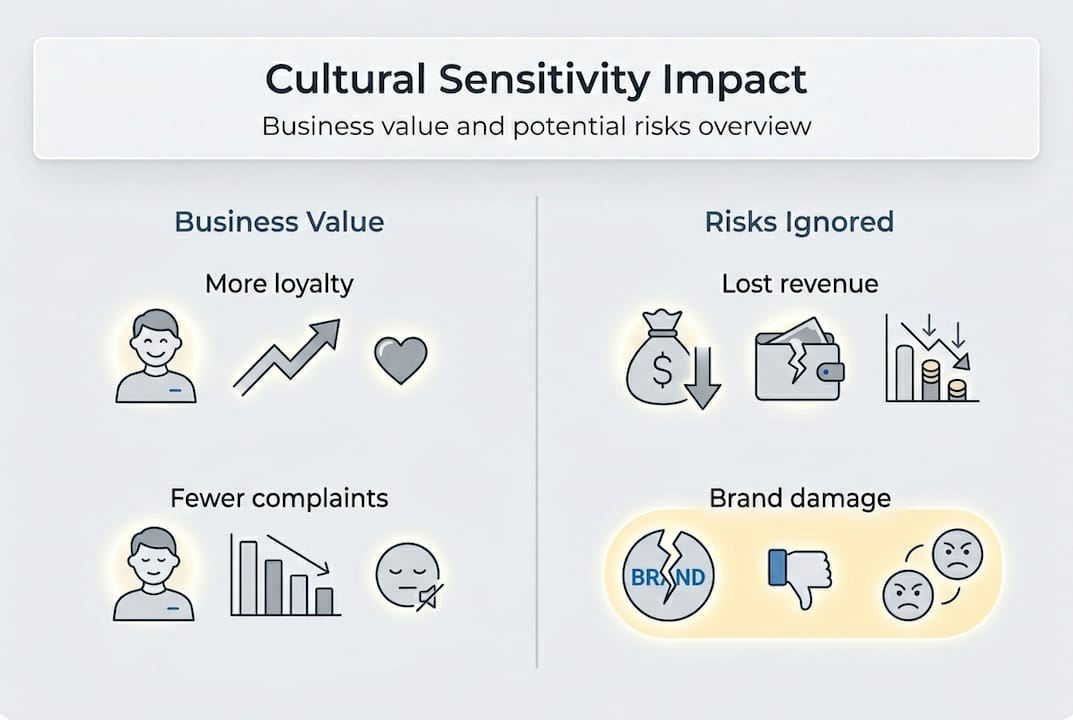
The business case for cultural sensitivity extends beyond customer satisfaction metrics. Companies that ignore cultural differences risk brand damage, customer churn, and lost revenue opportunities in international markets. Understanding these foundational concepts sets the stage for implementing practical methodologies that build cultural sensitivity systematically across support teams.
Methodologies to build cultural sensitivity in customer support teams
Cultural intelligence frameworks provide structured approaches to developing cultural sensitivity in customer support teams. The most widely adopted model includes four dimensions: knowledge (understanding cultural differences), strategy (planning culturally appropriate interactions), drive (motivation to engage across cultures), and action (adapting behavior in cross-cultural situations). Research on CQ training shows that experiential simulations yield the strongest gains in cultural competence, with blended learning approaches sustaining behavior change over time.
Effective training techniques combine multiple learning modalities to build lasting cultural sensitivity. Role-play exercises allow agents to practice culturally appropriate responses in realistic scenarios. Simulations immerse teams in virtual customer interactions that require cultural adaptation. AI coaching provides real-time feedback on communication patterns and cultural appropriateness during training sessions. Blended learning combines online modules with in-person workshops to reinforce concepts through varied formats.
Stepwise team development follows a proven sequence:
- Assessment: Evaluate current cultural intelligence levels across the team
- Immersive practice: Conduct simulation-based training with realistic cultural scenarios
- Mentoring: Pair less experienced agents with culturally skilled mentors
- Ongoing coaching: Provide continuous feedback and refinement opportunities
Ongoing coaching cements cultural sensitivity behaviors by addressing real-world challenges as they emerge. Regular feedback sessions help agents refine their approach based on actual customer interactions. Quality monitoring should include cultural appropriateness as a key performance indicator alongside traditional metrics.
Pro Tip: Implement experiential simulations before classroom training for highest cultural intelligence improvement. Teams that practice first, then learn theory, show 40% better retention of cultural concepts.
When building cultural sensitivity training programs, follow these essential practices:
- Focus on specific cultural dimensions relevant to your target markets
- Use authentic customer scenarios from actual support interactions
- Incorporate native speakers as cultural consultants and trainers
- Measure cultural competence improvements with standardized assessments
- Create psychological safety for agents to ask questions and make mistakes during training
Avoid these common training pitfalls:
- Teaching stereotypes instead of cultural frameworks
- One-time training without reinforcement
- Generic content not tailored to your customer base
- Ignoring regional variations within cultures
- Failing to connect cultural sensitivity to business outcomes
Companies that implement these methodologies systematically see measurable improvements in customer satisfaction across international markets. Outsourcing tips for telecom support emphasize cultural training as a critical success factor for global service operations. The investment in structured cultural intelligence development pays dividends through reduced escalations, improved first-contact resolution, and stronger customer loyalty in diverse markets.
Practical mechanics for adapting support to cultural differences
Market research informs every aspect of cultural adaptation in customer service. Companies must investigate communication preferences, service expectations, and cultural norms in each target market before launching support operations. This research reveals whether customers prefer formal or casual tone, direct or indirect communication, and immediate solutions or relationship-building conversations.
| Communication Style | Characteristics | Example Markets | Support Approach |
|---|---|---|---|
| Direct | Explicit, task-focused, values efficiency | Germany, Netherlands, US | Provide clear answers, skip small talk, focus on solutions |
| Indirect | Implicit, relationship-focused, values harmony | Japan, China, Middle East | Build rapport first, read between lines, avoid confrontation |
Language choices significantly impact customer perception of service quality. Language personalization strategies demonstrate that simple, structured language works better than complex vocabulary in multilingual support. However, cultural nuance matters more than literal translation. Idioms, humor, and colloquialisms require careful adaptation to avoid confusion or offense.

Multilingual native agents deliver superior customer satisfaction compared to non-native speakers or translation tools alone. Native speakers understand cultural context, recognize regional dialects, and adapt tone naturally to match customer expectations. Data shows native language support improves CSAT by 15% and reduces average handling time through more efficient communication.
Localizing etiquette requires understanding relationship-building customs across different regions. In Middle Eastern markets, customers expect personal connection and may discuss family or local events before addressing service issues. Support agents who engage authentically in these conversations build trust that translates to loyalty. In Latin American cultures, warmth and personal attention outweigh speed in determining service quality perceptions.
Practical adaptation strategies include:
- Researching greeting customs and appropriate formality levels for each market
- Adjusting response timing expectations based on cultural urgency norms
- Modifying complaint handling approaches to match cultural comfort with directness
- Personalizing communication channels to regional preferences (phone vs chat vs email)
- Training agents on cultural taboos and sensitive topics to avoid
Pro Tip: Avoid stereotypes and focus on authentic cultural nuances for effective adaptation. Treat cultural frameworks as starting points, not rigid rules, and always respond to individual customer cues.
The multilingual call center process integrates cultural adaptation at every touchpoint. From initial greeting to problem resolution to follow-up communication, culturally aware support teams adjust their approach based on customer cultural context. This systematic adaptation creates consistent, respectful experiences that drive customer satisfaction across diverse global markets.
Companies that master these practical mechanics see tangible business results. Customers feel understood and valued, leading to higher retention rates and positive word-of-mouth in international markets. The investment in cultural adaptation pays for itself through reduced churn and increased customer lifetime value across global operations.
Navigating challenges and measuring success in culturally sensitive service
Cultural response bias significantly affects customer satisfaction measurement accuracy across international markets. Research on cultural bias shows that identical service experiences receive different satisfaction ratings based on cultural tendencies. Latin American customers typically rate experiences 20-30% higher than Asian customers for the same service quality. This bias stems from cultural norms around politeness, criticism, and survey response patterns.
Empirical data reveals that service outcomes matter more than cultural matching in driving true customer satisfaction. While companies assume matching agent culture to customer culture improves results, research shows service quality, problem resolution, and communication effectiveness outweigh cultural similarity. Focusing exclusively on cultural matching misses the larger opportunity to improve actual service delivery.
| Brand | Cultural Approach | Market | Outcome |
|---|---|---|---|
| Swatch | Ignored cultural sensitivities in marketing | China | 30% wholesale drop, significant revenue loss |
| Dolce & Gabbana | Cultural insensitivity in advertising | China | Boycotts, store closures, brand damage |
| HSBC | Localized messaging and cultural adaptation | Global | Successful international expansion |
| Booking.com | Culturally adapted UX and communication | Europe, Asia | Market leadership in diverse regions |
Practical strategies to adjust metrics and avoid cultural pitfalls include:
- Establishing region-specific CSAT benchmarks rather than global averages
- Measuring outcome metrics like resolution rate and customer effort alongside satisfaction scores
- Conducting qualitative research to understand cultural satisfaction drivers in each market
- Training quality analysts to recognize cultural communication patterns in evaluations
- Comparing performance within cultural groups rather than across them
Measuring outcomes provides more reliable insights than assuming cultural match accuracy. Track metrics that reflect actual customer success: issue resolution on first contact, time to resolution, repeat contact rate, and customer retention. These objective measures reveal service effectiveness independent of cultural response tendencies.
Common challenges in global culturally sensitive support include:
- Balancing standardized processes with cultural flexibility
- Scaling cultural training across large, distributed teams
- Maintaining cultural expertise as markets and customer bases evolve
- Integrating cultural considerations into quality monitoring frameworks
- Avoiding cultural stereotypes while teaching cultural frameworks
- Managing costs of multilingual native-speaker staffing
Companies that successfully navigate these challenges implement systematic approaches to cultural sensitivity while maintaining operational efficiency. Best call center services combine cultural expertise with scalable processes that deliver consistent quality across diverse markets. The key is viewing cultural sensitivity as an ongoing capability development effort rather than a one-time training initiative.
Failure to adapt culturally carries significant business risks beyond customer dissatisfaction. Insensitive service interactions damage brand reputation, trigger social media backlash, and reduce customer lifetime value. In extreme cases, cultural missteps lead to boycotts and market exit. The Swatch example demonstrates how cultural insensitivity translated directly to a 30% wholesale decline in China, representing millions in lost revenue.
Successful companies treat cultural sensitivity as a strategic investment that protects brand equity and enables sustainable international growth. By measuring the right outcomes, adjusting for cultural biases, and continuously improving cultural competence, businesses build competitive advantages in global markets that compound over time.
Enhance your global customer service with CallTech
Scaling culturally sensitive customer service across international markets requires specialized expertise and infrastructure that most companies struggle to build internally. CallTech Outsourcing delivers multilingual contact center solutions designed specifically for businesses expanding into diverse global markets. With nearly 20 years of experience and native-speaking agents covering more than 15 European languages, CallTech helps companies implement the cultural sensitivity strategies outlined in this guide without the complexity of building in-house international teams.

Our culturally trained agents combine language fluency with deep understanding of regional communication preferences, service expectations, and cultural nuances that drive customer satisfaction. From initial cultural intelligence assessment through ongoing coaching and quality monitoring, CallTech provides the systematic approach to cultural sensitivity that global business leaders need. Whether you’re launching in new markets or improving existing international support operations, outsourcing call center services to a culturally competent partner accelerates results while controlling costs. Explore best call center services 2026 to discover how CallTech’s proven methodologies deliver measurable improvements in customer satisfaction, retention, and revenue across diverse markets. For telecom companies specifically, our outsourcing tips for telecom support demonstrate how cultural sensitivity drives competitive advantage in highly regulated international markets.
Frequently asked questions
What is cultural sensitivity in customer service?
Cultural sensitivity in customer service is the ability to understand and adapt customer interactions to respect cultural differences in communication styles and expectations. It’s essential for providing respectful, effective support in global markets. Companies that develop cultural sensitivity see higher satisfaction and retention across international customer bases.
How can companies train support teams to be culturally sensitive?
Companies should use cultural intelligence frameworks combined with experiential methods such as role-play and simulations. Effective training includes assessment, immersive practice, mentoring, and ongoing coaching. Blended learning approaches that combine multiple modalities sustain behavior change better than one-time training sessions.
Why is multilingual native support important in cultural sensitivity?
Native multilingual agents improve customer satisfaction by up to 15% and enable faster issue resolution through authentic communication. They understand cultural context, recognize regional dialects, and adapt tone naturally to match customer expectations. This cultural fluency builds trust and loyalty that non-native speakers and translation tools cannot replicate.
What challenges exist in measuring culturally sensitive customer service?
Cultural response biases can skew satisfaction scores significantly, with Latin American customers rating experiences 20-30% higher than Asian customers for identical service quality. Companies should adjust benchmarks by region and focus on outcome metrics like resolution rate and customer effort. Measuring actual service effectiveness provides more reliable insights than satisfaction scores alone.
What are risks of failing to adapt culturally in customer service?
Cultural insensitivity can result in boycotts, brand damage, and substantial revenue drops in international markets. Swatch experienced a 30% wholesale decline in China due to cultural missteps, while Dolce & Gabbana faced store closures and lasting reputation damage. Beyond immediate financial impact, cultural failures erode customer trust and make market recovery extremely difficult.
