
TL;DR:
- Scaling support requires designing workflows, knowledge bases, and escalation paths rather than just increasing headcount.
- AI handles 40 to 60 percent of tickets, but complex queries still need human agents to ensure quality.
- Successful global support depends on data-driven expansion, flexible outsourcing, and region-specific processes.
Scaling a global support operation sounds straightforward until your ticket queue triples overnight after entering three new markets. AI-powered automation can handle 92% of customer queries without human intervention in optimized environments, yet most telecom and SaaS companies still struggle to grow their support capacity without watching quality collapse or costs spiral. This guide unpacks the real frameworks, benchmarks, and field-tested strategies that help support leaders scale intelligently across languages, regions, and channels.
Table of Contents
- Why scaling support teams is harder than it looks
- The core frameworks for scalable customer support
- How global leaders scale: Metrics, AI, and best practices
- Avoiding common pitfalls in global scaling
- What most customer support leaders miss about true scale
- Next steps: Partnering for scalable support success
- Frequently asked questions
Key Takeaways
| Point | Details |
|---|---|
| Framework matters more than headcount | Efficient scaling blends automation, smart outsourcing, and process design—not just hiring. |
| AI and data unlock global scale | AI can resolve 40-60% of support tickets and data-led language rollout prevents wasted effort. |
| Avoid tech-only solutions for complexity | Chatbots need human support for nuanced global and telecom queries—hybrid models perform best. |
| Measure before you scale | Benchmarking FRT, FCR, CSAT, and language demand ensures your approach delivers results. |
Why scaling support teams is harder than it looks
Most leaders underestimate the compounding effect of adding markets. Each new region brings new languages, new regulatory expectations, new peak hours, and cultural nuances that trained agents handle naturally but automated systems often misread. Hiring faster is rarely the fix. The actual problem is operational complexity growing faster than your processes can absorb it.
Think about what happens when a European SaaS company launches in three new markets simultaneously. The ticket volume jumps 60%, but now those tickets arrive in German, Polish, and Romanian. Response time standards don’t change. Customer expectations don’t lower. But the infrastructure to support that diversity takes weeks or months to stand up properly if you haven’t planned for it. The team is suddenly stretched, morale dips, and the CSAT numbers tell the story clearly.
The benchmarks here are demanding. Top SaaS teams target a first response time under one hour for email and under two minutes for live chat, with first contact resolution rates between 70 and 75 percent, CSAT scores above 90 percent, and a cost per ticket between $5 and $10. Telecom companies using AI or outsourcing report 20 to 30 percent cost reductions and up to 40 percent FCR improvement. These aren’t aspirational numbers, they’re the competitive floor.
Common hurdles that derail scaling efforts include:
- Volume spikes during product launches, billing cycles, or outages that overwhelm in-house teams with no overflow capacity
- Inconsistent training when new agents are onboarded quickly without deep product or cultural knowledge
- Language mismatches where customers receive responses in the wrong dialect or tone
- Technology fragmentation when CRMs, ticketing tools, and communication platforms don’t talk to each other
- Cultural misalignment where scripts and templates feel cold or inappropriate for specific regional audiences
“The biggest scaling mistake is treating growth like a staffing equation. Real scale comes from designing workflows, knowledge bases, and escalation paths that work the same way regardless of volume or language.”
Support scaling strategies that work at the team level don’t always translate to global operations without deliberate redesign. The leaders who scale well are scaling smarter, not just faster, and they plan the operational architecture before the headcount.
The core frameworks for scalable customer support
Once you understand what makes scaling hard, the next question is which operational model actually fits your growth stage, budget, and complexity. There is no universal answer. What works for a 50-person SaaS startup entering Western Europe looks very different from what a mid-market telecom company needs when expanding into six new Eastern European countries.
Here is a direct comparison of the four main models:
| Model | Best for | Key advantage | Key risk |
|---|---|---|---|
| In-house | Early stage, single language | Full brand control | High cost, hard to scale fast |
| Outsourced | Multilingual, high volume | Language coverage, fast ramp | Requires strong vendor management |
| Hybrid | Mid-market to enterprise | Flexibility, overflow capacity | Complexity in process alignment |
| AI-driven | Repetitive, high-volume FAQs | Low cost per ticket | Fails on complex or emotional queries |
The outsourced vs in-house support comparison isn’t just about price. It’s about time-to-market, language coverage, and your ability to absorb unexpected surges. A telecom company preparing for a major product launch in four markets cannot hire and train 40 native-speaking agents in six weeks. But an experienced outsourcing partner can activate them.
AI-driven support is powerful but carries real risk when over-applied. Trade Republic replaced chatbots with 1,000+ human agents after discovering that automation alone couldn’t handle the emotional complexity and nuanced queries of financial customers. The lesson is sharp: chatbot-only strategies fail in high-stakes, complex verticals. Customers dealing with billing errors, service outages, or subscription cancellations need to feel heard, not deflected.
Key points to guide your model selection:
- Choose in-house when your customer base is concentrated in one or two languages and your support load is predictable
- Choose outsourced when speed to market, language diversity, or cost per ticket are primary concerns
- Choose hybrid when you need core in-house expertise on tier-2 issues with external capacity handling tier-1 volume
- Use AI automation strategically for FAQs, password resets, order tracking, and simple troubleshooting, always with a clear escalation path
One practical note on multilingual rollout: start with email support before expanding to chat or voice. Email allows agents time to translate carefully, consult knowledge bases, and craft accurate responses. Chat and voice demand real-time fluency and cultural confidence that takes longer to certify. SaaS growth strategies consistently show that phased channel rollout reduces quality incidents during expansion.
Pro Tip: Build flexible outsourced capacity into your annual plan even if you don’t use it every month. The cost of maintaining that relationship is far lower than scrambling for emergency coverage during a product launch or unexpected outage.
How global leaders scale: Metrics, AI, and best practices
The companies that scale support efficiently share a few specific habits. They measure relentlessly, they prioritize languages based on data not assumptions, and they treat AI as a force multiplier rather than a cost-cutting gimmick.
The numbers are striking. AI automation now handles 40 to 60 percent of tickets automatically, covering routine FAQs and basic troubleshooting across high-volume environments. PhonePe achieved a 92 percent DIY resolution rate with just one human agent per 20 million transactions, maintaining CSAT above 70 percent. That is not a future scenario. It is a live benchmark that forward-thinking teams are already measuring themselves against.
Here’s how the metrics look in practice for scaling teams:
| Metric | Target (top performers) | Why it matters |
|---|---|---|
| First response time (email) | Under 60 minutes | Sets initial customer confidence |
| First response time (chat) | Under 2 minutes | Determines real-time satisfaction |
| First contact resolution | 70 to 75 percent | Reduces repeat contacts and cost |
| CSAT | 90 percent or above | Reflects customer loyalty and retention |
| Cost per ticket | $5 to $10 | Benchmarks operational efficiency |
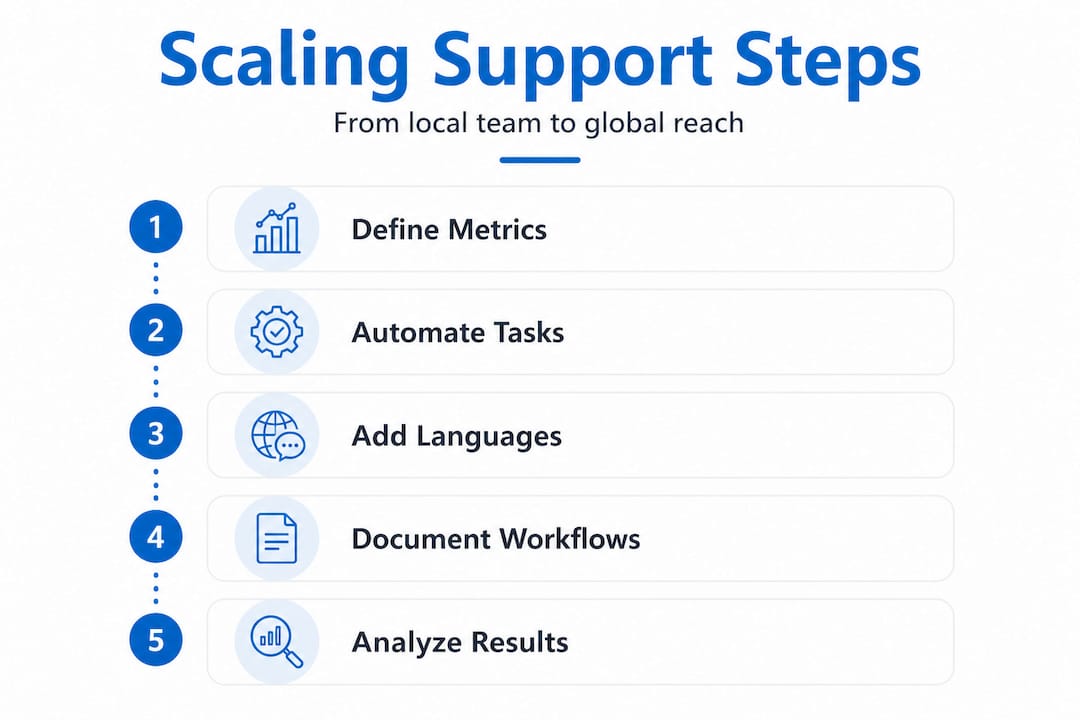
The step-by-step execution approach that top performers follow looks like this:
- Audit ticket volume by language and market before committing to any expansion decisions. Data tells you where customers actually need help.
- Identify your top five ticket categories by volume and assess which ones AI can resolve reliably without escalation.
- Launch email-first in new languages to validate quality before moving to chat or voice channels where real-time fluency is critical.
- Set clear escalation thresholds so AI or tier-1 agents know exactly when to transfer to a specialist.
- Track FCR and CSAT by language and channel separately, not just in aggregate, so you can spot regional quality gaps before they compound.
Smart leaders also look at multilingual support conversions to understand how language access directly affects revenue, not just satisfaction scores. When customers get support in their native language, conversion rates and retention both improve in measurable ways. Treating multilingual support as a cost center is the wrong frame. It is a growth lever.
Building the workflow for global scale means documenting escalation paths, defining SLA ownership across channels, and creating language-specific knowledge bases that agents can actually use. Without that infrastructure, even well-staffed teams will produce inconsistent outcomes. SaaS alignment case studies confirm that cross-functional process clarity is one of the clearest predictors of support efficiency at scale.

Avoiding common pitfalls in global scaling
Even well-resourced teams with strong frameworks stumble. The reasons are almost always predictable in hindsight and preventable with the right guardrails in place.
The most damaging mistakes in global support scaling are:
- Relying on chatbots for complex verticals. Trade Republic’s reversal to 1,000+ human agents is the clearest recent example. When customers have high-stakes questions about finances, contracts, or service continuity, automation that deflects rather than resolves creates frustration and churn.
- Adding languages without data. Teams often prioritize languages based on gut feeling or market ambition rather than actual ticket volume and revenue contribution. This leads to over-investing in markets that generate minimal support demand while under-serving regions with real need.
- Signing inflexible vendor contracts. A fixed-seat outsourcing contract signed in January becomes a liability by March when volume drops or demand shifts. Build in flexible terms that allow you to scale up or down within agreed parameters.
- Skipping warm handoffs. When a chatbot or first-line agent transfers a customer to a specialist, the transition quality matters enormously. A warm handoff means the receiving agent already knows the context. A cold transfer means the customer repeats everything, and satisfaction drops sharply.
- Aggregating metrics too broadly. Tracking CSAT at the company level masks regional performance gaps. A strong overall score can hide a specific language market where resolution quality is poor, and by the time it becomes visible in aggregate, churn has already occurred.
“Language rollout without data is guesswork. Let ticket volume and revenue impact tell you which language to support next, not which market feels exciting.”
This is reinforced clearly in multilingual support best practices, where the guidance is consistent: base your language expansion on support ticket data and revenue analysis, deploy hybrid AI-human models with warm handoffs for complex telecom and SaaS scenarios, and measure each language segment independently.
Dedicated multilingual support agents who are embedded in a specific language market bring contextual knowledge that general agents simply cannot replicate quickly. They know the communication style expectations, the common complaint patterns for that region, and the regulatory nuances that affect how issues get resolved.
Pro Tip: Before signing any outsourcing contract for a new language market, run a 60-day pilot covering email-only support. This gives you real performance data, reveals hidden training gaps, and lets you evaluate vendor quality before committing to full-scale deployment.
What most customer support leaders miss about true scale
Here is something that nearly two decades of working with global support operations has made very clear: most leaders confuse scale with size. They think scaling support means adding more agents, more seats, more tools. It rarely does.
True scale is a workflow problem, not a headcount problem. When you design your escalation paths correctly, invest in language-specific knowledge bases, and integrate AI at the right points in the ticket flow, you can handle significantly higher volumes without proportional cost increases. The teams that do this well look surprisingly lean compared to their ticket volumes.
What makes this difficult is that the conventional playbook, copy what Amazon or Salesforce or Spotify does, almost never transfers cleanly. Those companies built their support infrastructure at a different scale, with different customer bases, different tooling budgets, and different organizational structures. A mid-market SaaS company applying their framework gets a poor fit that wastes both time and budget.
The mindset shift that matters most is this: data before decisions, always. Before you add a language, audit the tickets. Before you deploy a chatbot, map which query types it will handle and which ones it will fail. Before you sign an outsourcing contract, define the SLA metrics you’ll hold vendors to. The companies we see succeed consistently at global scale are the ones who treat support operations like a product: designed deliberately, iterated based on evidence, and measured rigorously.
Real support case studies reinforce this pattern. The companies that grew support efficiently didn’t get there by hiring faster. They got there by building cleaner processes and choosing outsourcing partners who could execute those processes reliably across multiple languages without constant oversight.
Next steps: Partnering for scalable support success
If the frameworks and benchmarks in this article have highlighted gaps in your current support setup, the practical next step is identifying where outsourced multilingual capacity can close those gaps without requiring months of internal hiring and training.

CallTech Outsourcing has helped telecom and SaaS companies scale multilingual support across more than 15 European languages since 2005. Whether you need a fully managed multilingual call center outsourcing solution or targeted support to enhance engagement with multilingual support in specific markets, our teams integrate directly into your workflows with modern VOIP, CRM connectivity, and scalable staffing. For teams evaluating infrastructure options, our guide to best call center platforms is a practical resource for matching technology to your operational model. Reach out to discuss how a tailored outsourcing partnership can help you move faster in the markets that matter most.
Frequently asked questions
What is the industry benchmark for customer support efficiency?
Top SaaS teams aim for a first response time under 1 hour by email, under 2 minutes by chat, and a cost per ticket of $5 to $10 with 70 to 75 percent first contact resolution, alongside CSAT scores above 90 percent.
How much can AI reduce the workload for support teams?
AI can automate 40 to 60 percent of incoming tickets, particularly routine FAQs and simple troubleshooting, allowing agents to focus on complex issues while maintaining strong satisfaction scores.
When is it time to add new languages or channels for support?
Prioritize languages based on ticket volume and revenue impact first, then expand channel coverage starting with email before adding real-time chat or voice support as demand justifies it.
Should I use chatbots for complex customer queries?
Chatbots handle simple, repetitive requests well but should always be paired with human agents for complex or high-stakes issues, as Trade Republic demonstrated when it replaced chatbots with 1,000+ agents after automation failed to meet customer expectations.
What is a warm handoff and why is it important?
A warm handoff is a structured transfer where the receiving agent already has full context before engaging the customer, preventing repetition and protecting satisfaction in complex escalations across telecom and SaaS environments.
