
TL;DR:
- A well-designed multilingual support workflow can eliminate support bottlenecks across multiple markets.
- Choosing the right tools and fostering workflow flexibility are key to scalable, consistent customer support.
- Continuous testing and optimization ensure support operations adapt to market changes and improve customer satisfaction.
Missed tickets piling up, a French-speaking customer stuck in an English-only queue, and your team scrambling to cover three time zones at once. Sound familiar? This is the reality for many telecom and SaaS operations leaders managing customer support across multiple markets. The good news is that a well-designed, outsourced multilingual support workflow can eliminate these bottlenecks entirely. This guide walks you through every stage: assessing your needs, selecting the right tools and partners, designing efficient processes, and continuously optimizing for scale. By the end, you will have a clear, actionable framework for building support operations that grow with your business.
Table of Contents
- Assessing your support needs and setting goals
- Selecting tools and partners for multilingual support
- Designing an efficient multilingual support workflow
- Testing, launching, and optimizing your workflow
- A seasoned perspective: Why workflow flexibility matters more than perfection
- Scale with confidence: Take your customer support workflow global
- Frequently asked questions
Key Takeaways
| Point | Details |
|---|---|
| Clear preparation is vital | Defining needs and KPIs before outsourcing simplifies workflow design and improves results. |
| Right tools drive quality | Selecting platforms and partners that match your requirements is crucial for seamless support. |
| Workflow design fuels consistency | Documented, multilingual workflows ensure customers receive the same high-quality experience worldwide. |
| Continuous optimization wins | Regular testing, feedback, and iteration keep support workflows agile and effective. |
Assessing your support needs and setting goals
Preparation is the first critical step before you design or redesign any workflow. Many operations leaders jump straight into tool selection or partner negotiations without a clear picture of what they actually need. That approach almost always leads to wasted budget and misaligned expectations.
Start by mapping your current support landscape. How many tickets, calls, or chats does your team handle per day? Which languages are your customers using, and are there gaps in coverage? Which channels matter most: voice, email, live chat, or social? Knowing your volume by channel and region gives you a concrete baseline to work from.
Next, define your key performance indicators before outsourcing begins. The most critical ones for multilingual operations are:
- First Response Time (FRT): How quickly a customer receives an initial reply
- Customer Satisfaction Score (CSAT): A direct measure of customer experience quality
- Resolution Time: How long it takes to fully close a ticket
- First Contact Resolution (FCR): The percentage of issues resolved without escalation
- Language accuracy rate: Quality of communication in each supported language
As workflow optimization steps show, defining clear KPIs and scope is essential to scalable outsourcing because support needs vary widely by industry and region.
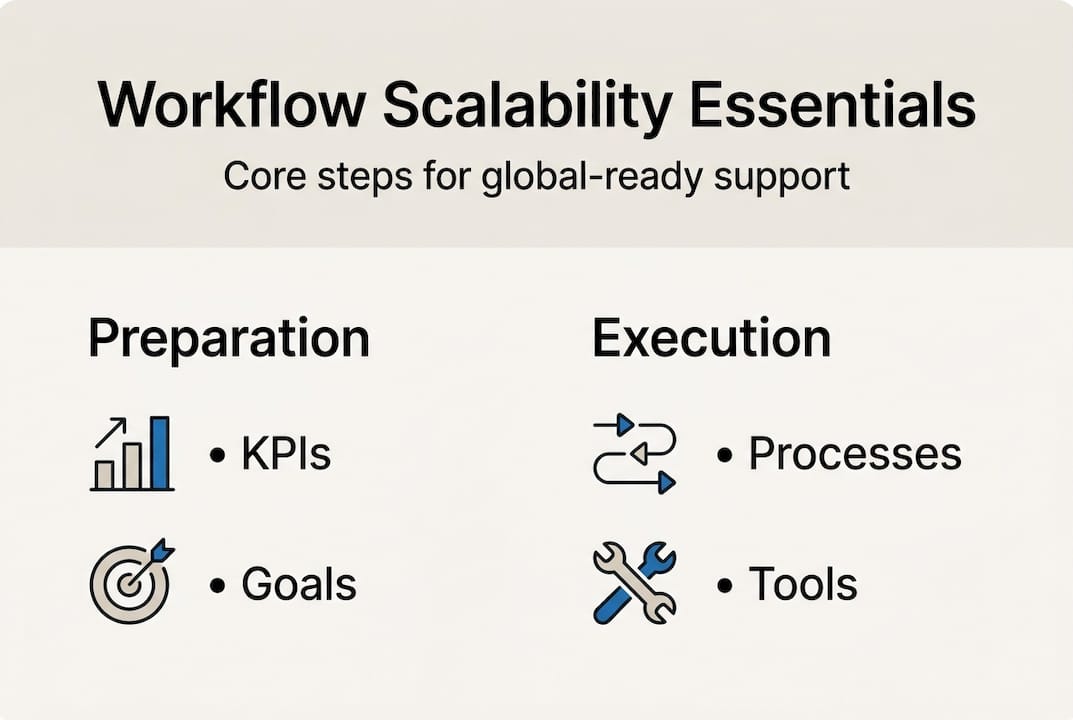
Aligning your support goals with broader business objectives is equally important. If your company is expanding into Eastern Europe, your support team needs to be ready before the marketing campaign launches, not six weeks after.
| Dimension | Questions to answer |
|---|---|
| Volume | Daily tickets, peak hours, seasonal spikes |
| Languages | Current coverage vs. needed coverage |
| Channels | Voice, email, chat, social media |
| Time zones | Coverage gaps, overnight support needs |
| KPIs | FRT, CSAT, FCR targets by market |
Pro Tip: Map your most common customer journeys before you outsource anything. Identify where customers get stuck, where tickets escalate unnecessarily, and where language barriers cause the most friction. These are your highest-priority workflow fixes.
Selecting tools and partners for multilingual support
Once your needs are clear, it is time to choose the right technology and partners. This decision will shape your workflow for years, so it deserves careful evaluation rather than a quick shortlist comparison.
For technology, your core stack should cover ticketing, translation or language routing, and automation. When evaluating platforms, prioritize native multilingual support, CRM integration capability, and reliability at scale. A tool that works beautifully in English but struggles with right-to-left languages or special characters is not a real multilingual solution.
The best outsourcing tools and providers dramatically impact support efficiency and customer experience, which is why due diligence matters as much as the initial demo.
Here is a practical process for evaluating both tools and partners:
- List your non-negotiables. Identify features you cannot operate without: specific language support, GDPR compliance, VOIP compatibility, or SaaS integrations.
- Request live demos in your target languages. Do not accept English-only demonstrations for a multilingual rollout.
- Check telecom compliance. Partners working in regulated markets need to meet local data and communication standards.
- Review cost models carefully. Per-seat, per-ticket, and per-minute pricing all behave differently at scale. Model your expected costs at 2x and 3x current volume.
- Ask for references from similar industries. A partner with strong SaaS experience may not understand telecom billing complexity.
| Evaluation factor | What to check |
|---|---|
| Language support | Native speakers vs. machine translation |
| Platform reliability | Uptime SLAs, redundancy |
| SaaS/telecom integration | API availability, CRM connectors |
| Compliance | GDPR, local telecom regulations |
| Pricing model | Scalability at higher volumes |
For SaaS companies specifically, reviewing support platforms for SaaS can help you identify platforms built with your integration needs in mind.
Pro Tip: Always test multilingual AI features using real support scenarios from your ticket history. Synthetic test cases rarely surface the edge cases that matter most to your customers.
Designing an efficient multilingual support workflow
With tools and partners in place, design your workflow for both simplicity and flexibility. The most common mistake here is overcomplicating the process in an attempt to cover every possible scenario upfront.
As designing call center processes demonstrates, well-designed workflows ensure multilingual support teams can deliver consistent service levels through clearly defined processes. The emphasis is on clarity and repeatability.

Your workflow design should address ticket routing, escalation paths, and SLA definitions for each language and channel. A ticket in German should follow the same logical path as one in English, even if different agents handle it. Consistency in process is what allows quality to scale.
Key multilingual workflow best practices include:
- Standardize handoff protocols so agents know exactly when and how to escalate a ticket across language groups
- Align shifts with customer time zones rather than your headquarters’ business hours
- Build QA review cycles into the workflow, not as an afterthought but as a scheduled, recurring step
- Use visual process diagrams that agents in any language can follow without ambiguity
- Define SLAs per channel and language, because response time expectations differ between a live chat and an email queue
Companies with standardized multilingual processes see up to 40% higher CSAT scores compared to those running ad hoc, language-by-language operations. That number reflects the compounding benefit of consistency: customers get the same quality experience regardless of which language they use.
For teams scaling rapidly, cloud-based support solutions make it far easier to add new language queues or regional teams without rebuilding your infrastructure from scratch.
Pro Tip: Document every workflow process and pair the documentation with a visual diagram. Written SOPs get ignored; a clear flowchart gets used. Keep diagrams updated every quarter as your processes evolve.
Testing, launching, and optimizing your workflow
After workflow design comes the crucial phase of testing and continual improvement. This is where many operations leaders lose momentum, either rushing the launch or treating the initial rollout as the finish line.
Before going live, work through this launch checklist:
- Test scripts across all supported languages with native speakers, not just bilingual reviewers
- Run QA checklists on a sample of tickets processed during the pilot period
- Set up real-time monitoring dashboards so you can catch spikes in wait time or error rates immediately
- Confirm escalation paths work end-to-end, including cross-language handoffs
- Brief all agents on the workflow diagram, SLAs, and escalation triggers before launch day
Post-launch, collecting feedback from diverse customer groups is essential. A CSAT survey in Spanish will surface different issues than one in Polish. Segment your feedback data by language and region to identify where the workflow is underperforming for specific markets.
“Ongoing optimization is not a sign that your workflow was poorly designed. It is proof that your team is paying attention. The best support operations treat every data point as an opportunity to improve, not as evidence of failure.”
As successful support leaders demonstrate, systematically testing and optimizing workflows for agility and quality is what separates scalable operations from stagnant ones.
Here are the metrics you should track consistently:
| Metric | Why it matters | Review frequency |
|---|---|---|
| First Response Time | Measures speed of initial contact | Daily |
| QA Score | Tracks agent quality per language | Weekly |
| CSAT | Customer satisfaction by market | Weekly |
| Net Promoter Score (NPS) | Long-term loyalty indicator | Monthly |
| Escalation rate | Signals workflow gaps | Weekly |
Review best call center services and outsourcing support tips to benchmark your performance against industry standards and identify areas where your current setup may be falling short.
A seasoned perspective: Why workflow flexibility matters more than perfection
After nearly 20 years of helping telecom and SaaS companies build multilingual support operations, we have seen the same pattern repeat itself. A team spends months designing a “perfect” workflow, complete with detailed SOPs, decision trees for every scenario, and rigid approval chains. Then a new market launches, a product changes, or a regulatory update arrives, and the whole structure needs rebuilding.
The uncomfortable truth is that perfect documentation is often the enemy of operational agility. The companies that scale most effectively are not the ones with the most detailed process manuals. They are the ones that design workflows with adaptation built in from the start.
This means shorter feedback loops, quarterly workflow reviews, and agents who are empowered to flag process gaps rather than just follow scripts. It means treating your workflow as a living system, not a finished product.
Leaders who have absorbed cost-saving lessons from outsourcing know that the real efficiency gains come from iteration, not from getting everything right on day one. Design for adaptability first. Perfection can wait.
Scale with confidence: Take your customer support workflow global
Ready to put your new workflow into action with global-scale support? Here is your next step.
At CallTech Outsourcing, we have spent nearly 20 years helping telecom and SaaS companies build and run multilingual support operations across more than 15 European languages. Our teams work with modern VOIP infrastructure, CRM integration, and secure communication systems to deliver workflows that are both efficient and scalable from day one.

Whether you are starting from scratch or looking to optimize your workflow that already exists, we can help you design, staff, and continuously improve a support operation that grows with your business. Explore how our outsourcing call center services can reduce your operational burden while improving the customer experience across every market you serve.
Frequently asked questions
What are the most important KPIs for customer support workflows?
First Response Time, CSAT, and Resolution Time are essential because they directly measure the speed and quality of your support operation. Tracking these consistently allows you to identify gaps before they affect customer retention.
How can I ensure consistent quality across outsourced multilingual teams?
Standardized multilingual processes ensure consistent service levels, so invest in shared QA frameworks, regular training, and scheduled review cycles across all language teams. Consistency in process is what makes quality repeatable at scale.
What are the main risks of workflow automation for support teams?
Over-automation can cause misunderstandings, especially in nuanced or emotionally sensitive customer interactions, so always balance automation with clear human escalation paths. Automation tools should be tested in real-world support scenarios before full deployment.
How do cloud-based contact centers help with scalability?
Cloud-based contact centers provide flexible infrastructure that lets you add new languages, regions, or channels without rebuilding your entire tech stack. This makes them the practical choice for any operation planning international growth.
