
TL;DR:
- Outsourcing CATI surveys enables rapid, cost-effective, and high-quality multilingual customer research across international markets. It provides scalable capacity, professional interviewers, and real-time data validation, surpassing in-house operations’ limitations. Effective partner selection and ongoing program management are crucial for maximizing insights and ROI.
Most telecom and SaaS executives assume that running multilingual customer surveys across international markets is a resource-heavy, slow, and error-prone process best handled internally. That assumption costs companies real insight. CATI (Computer Assisted Telephone Interviewing) survey outsourcing has quietly become one of the most efficient ways to gather high-quality customer data at scale, across dozens of language markets, without building a massive internal operation. This article breaks down exactly how it works, what it costs, and how to choose the right partner.
Table of Contents
- Understanding CATI survey outsourcing
- Key advantages of outsourcing multilingual CATI surveys
- CATI outsourcing vs in-house: A cost and quality comparison
- Best practices for selecting a CATI survey outsourcing partner
- What most leaders miss about CATI survey outsourcing
- Streamline your multilingual surveys with expert outsourcing
- Frequently asked questions
Key Takeaways
| Point | Details |
|---|---|
| Outsourcing simplifies surveys | CATI survey outsourcing removes operational complexity and accelerates deployment for global customer research. |
| Multilingual insights at scale | Businesses gain access to native speakers and scalable technology for meaningful multilingual data. |
| Cost and quality advantages | Outsourcing CATI surveys typically delivers higher quality and lower costs than building in-house teams. |
| Strategic partner selection is crucial | Careful vetting of outsourcing providers ensures sector expertise, security, and long-term success. |
Understanding CATI survey outsourcing
CATI stands for Computer Assisted Telephone Interviewing, a structured research method where trained interviewers conduct phone surveys guided by software that manages question routing, response capture, and real-time validation. The system prompts interviewers with questions, auto-records responses, and flags inconsistencies during the call. This real-time quality control is what separates CATI from basic phone surveys.
For telecom and SaaS companies operating across Europe and international markets, running CATI surveys internally creates immediate friction. You need multilingual interviewers, localized scripts, compliance with data privacy laws in each country, VOIP infrastructure, and trained supervisors. That is a significant overhead for a function that is not your core product.
Outsourcing CATI surveys means handing that entire operation to a specialized provider. You define your research objectives, approve the survey design, and receive clean, structured data. The outsourcing partner handles interviewer recruitment, language matching, quality assurance, and delivery.
Key challenges that outsourcing resolves for telecom and SaaS businesses include:
- Language coverage: Building internal teams fluent in German, Polish, Dutch, French, and six other languages is expensive and slow
- Interviewer expertise: Skilled CATI interviewers are a specialized workforce, not general customer service agents
- Technology and infrastructure: Maintaining CATI-specific software, VOIP systems, and CRM integrations requires constant investment
- Compliance burden: GDPR and country-specific data handling rules vary significantly across European markets
- Scalability: Survey campaigns often spike around product launches or regulatory cycles, requiring surge capacity that in-house teams cannot absorb
“The real advantage of outsourcing CATI surveys is not just cost. It is speed to insight. A well-configured outsourcing partner can deploy a 10-language survey campaign in days, not months.”
Understanding what call centers for market research actually do at the operational level helps set realistic expectations before you select a partner. You can also review benchmark survey examples to understand industry standards for response quality and question design before briefing any provider.
Pro Tip: Before outsourcing, write a one-page research brief that defines your target respondent profile, key questions, success metrics, and language markets. Providers who can respond to that brief with specific execution plans are far more qualified than those who only offer generic pitches.
Key advantages of outsourcing multilingual CATI surveys
Once you understand the mechanics, the business case becomes clear. Outsourcing multilingual CATI surveys delivers advantages that in-house operations simply cannot replicate at the same cost or speed. Here is why executives in fast-moving telecom and SaaS organizations increasingly rely on outsourcing partners for their international research.
- Rapid multilingual deployment. A specialist provider already has trained, native-speaking interviewers in multiple European languages. You skip the 3 to 6 month hiring cycle and start fielding calls within weeks.
- Expert interviewers and validated technology. CATI specialists know how to manage respondent resistance, reduce survey abandonment, and maintain consistent question delivery. That skill directly improves your data quality.
- Higher response rates. Outsourced teams with native-speaking interviewers consistently outperform in-house teams using non-native staff. Respondents are more willing to complete longer surveys with fluent, culturally aware interviewers.
- Data integrity and validation. Real-time CATI software flags outlier responses, checks logic errors, and produces clean datasets. You receive data that does not require extensive post-processing.
- Scalable capacity. If your survey scope expands from 500 to 5,000 respondents across five new markets, the outsourcing provider scales without you adding headcount.
- Lower total cost. When you account for technology licensing, training, management overhead, and turnover costs, in-house CATI management typically runs 40 to 60 percent higher than a well-negotiated outsourcing contract.
Effective market research outsourcing advantages are well-documented. Companies that apply proven market research strategies to their outsourcing decisions consistently generate better ROI from survey investments than those who treat research as an ad hoc function.
When partnering with outsourcing providers, the quality of your briefing process determines the quality of your output. Providers who have worked extensively in telecom and SaaS already understand churn analysis frameworks, NPS (Net Promoter Score) benchmarks, and the types of customer segments that matter most to your leadership team.
Pro Tip: Ask potential CATI partners for completion rate data segmented by language market. A strong provider should show completion rates above 70 percent in each language they cover. If they cannot share this data, that is a red flag.
CATI outsourcing vs in-house: A cost and quality comparison
Numbers tell the story more clearly than general claims. Below is a comparison of the key cost and quality dimensions between outsourced and in-house CATI survey management for a typical telecom or SaaS company running multilingual campaigns across five European markets.

| Dimension | Outsourced CATI | In-house CATI |
|---|---|---|
| Setup time | 2 to 4 weeks | 3 to 6 months |
| Interviewer language coverage | 15+ languages available | Limited to current staff |
| Technology cost | Included in contract | $20,000 to $80,000 annually |
| Training cost per interviewer | Absorbed by provider | $2,000 to $5,000 per hire |
| Quality control | Automated and supervised | Manual, inconsistent |
| Scalability | Immediate | Slow, headcount-dependent |
| Average cost per completed survey | $8 to $15 | $20 to $40 |
| GDPR compliance management | Provider-handled | Internal legal overhead |
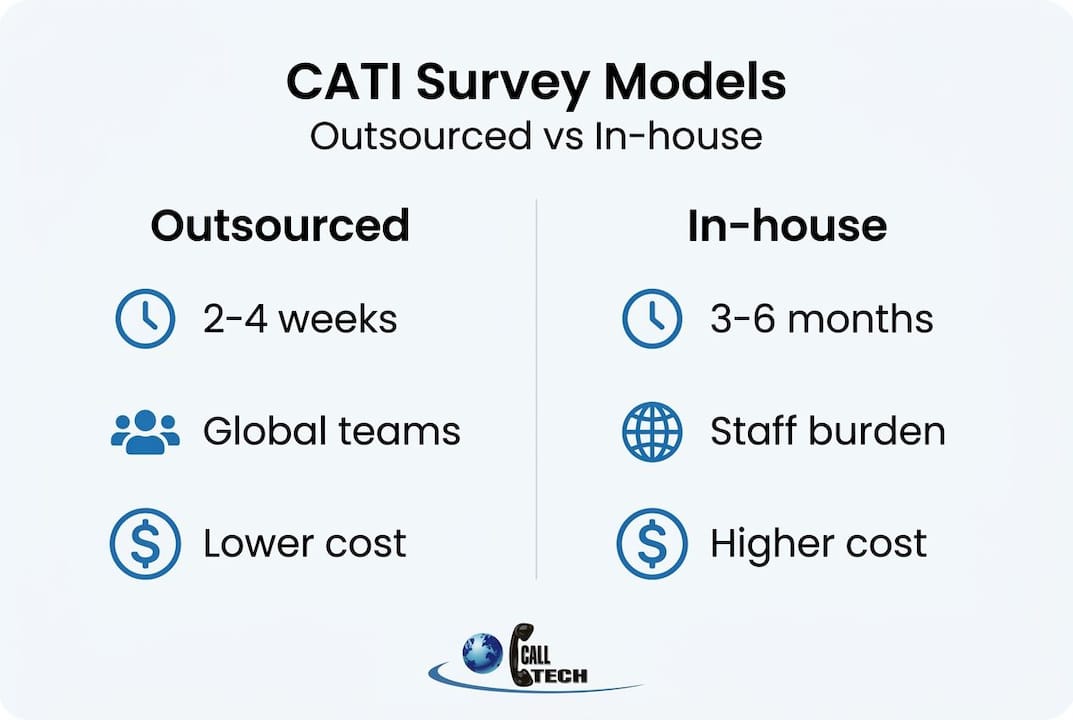
The real cost comparison between these two models is significant when you factor in hidden costs that executives rarely account for upfront. Staff turnover in call center roles runs high globally, and every departing interviewer takes institutional knowledge and survey familiarity with them.
Telecom and SaaS companies that have shifted to outsourced CATI operations report typical savings in the range of 35 to 55 percent over their previous in-house models, once all operational costs are included. The savings are highest when the company was previously running surveys in more than three languages with separate internal teams.
Potential risks of outsourcing and how to mitigate them include:
- Data security concerns: Mitigate by requiring ISO 27001 certification, reviewing the provider’s data processing agreements, and auditing their security protocols before contracting
- Loss of control over interviewer quality: Mitigate by requiring recorded call samples, regular quality score reports, and weekly performance reviews during the first campaign
- Script localization errors: Mitigate by having a native-speaking internal reviewer approve each language version before launch
- Communication gaps: Mitigate by assigning a single project manager on both sides and using shared project tracking tools
Strategies for boosting efficiency with outsourcing apply directly to CATI operations. Companies that define clear SLAs (Service Level Agreements), establish completion rate thresholds by market, and schedule bi-weekly data reviews with their provider extract far more value from the engagement.
If you are still evaluating the outsourcing versus in-house support question more broadly, the CATI context reinforces the same conclusion: specialized work belongs with specialists who have the scale, tools, and talent to do it reliably.
Best practices for selecting a CATI survey outsourcing partner
Choosing the wrong provider will set your research program back by months. The selection process deserves the same rigor you apply to any major technology or services vendor. Here is a practical framework.
Step 1: Define your language and market requirements first. Before contacting any provider, list every language market you plan to survey in the next 12 months, including projected sample sizes. This filters out providers immediately if they cannot cover your specific language combination.
Step 2: Verify interviewer quality, not just language availability. Many providers claim language coverage but use bilingual staff rather than native speakers. Request a test call in each language and evaluate fluency, tone, and question delivery.
Step 3: Audit their CATI technology stack. Ask about the software platform, CRM integration capabilities, real-time reporting access, and how they handle data exports. You need to receive structured data that feeds directly into your analytics tools without manual reformatting.
Step 4: Review their sector experience. A provider who has run NPS surveys for SaaS companies or churn analysis interviews for telecom operators understands your respondent context. They will flag question design issues before launch, not after you receive confusing data.
Step 5: Evaluate compliance and data security. For European markets, GDPR compliance is non-negotiable. Review their data processing agreements, ask about data storage locations, and request their ISO certifications.
Use the following template when comparing providers side by side:
| Criteria | Provider A | Provider B | Provider C |
|---|---|---|---|
| Languages covered | 12 | 8 | 15+ |
| Telecom/SaaS experience | Yes | No | Yes |
| ISO 27001 certified | Yes | Yes | Yes |
| Completion rate (avg) | 74% | 65% | 78% |
| Setup time | 2 weeks | 4 weeks | 2 weeks |
| CRM integration | Yes | No | Yes |
| Pricing per complete | $10 | $12 | $9 |
Reviewing guidance on outsourcing telecom support tips gives you additional criteria tailored to the telecom sector specifically. For companies planning rapid growth, scalable outsourcing strategies and the scalable outsourcing guide outline how to structure contracts that grow with your research demands without renegotiating from scratch each time.
Pro Tip: Ask every provider: “How do you handle a significant drop in completion rates mid-campaign?” Their answer reveals whether they have systematic quality recovery processes or whether they simply report the problem and wait for your instructions.
What most leaders miss about CATI survey outsourcing
After nearly 20 years of working with telecom and SaaS companies on multilingual research and customer support operations, we have noticed one consistent pattern among executives who underperform on CATI outsourcing: they treat surveys as isolated events rather than continuous intelligence programs.
A single survey campaign delivers a data snapshot. It tells you what customers thought in a specific market at a specific moment. That is useful, but it is not what drives the companies that consistently outpace their competitors on customer retention and product-market fit.
The executives who extract maximum value from CATI outsourcing run rolling survey programs tied to specific business events: post-onboarding assessments, six-month satisfaction checkpoints, post-churn interviews, and annual NPS benchmarks. Their outsourcing partner is not just a vendor. It is a research infrastructure that compounds in value because interviewers know the product, supervisors know the market context, and data pipelines are already configured.
We also see leaders overestimate what their internal teams can actually manage. Building a multilingual CATI program in-house looks feasible on a spreadsheet. The reality is that managing interviewer turnover, maintaining CATI software, retraining staff for each new survey wave, and ensuring compliance across six countries is a full-time operation. Companies that try to run this alongside their core business consistently cut corners on quality.
The uncomfortable truth is that in-house CATI programs often produce worse data at higher cost than outsourced equivalents, precisely because they lack the specialized management structures that a dedicated provider builds over years of focus.
Accessing the right global market research insights requires sustained investment in research infrastructure, not periodic surveys when leadership decides it is time to “check in” on customer sentiment. Build the program first, then trust a capable partner to run it reliably.
Streamline your multilingual surveys with expert outsourcing
If the case for outsourcing CATI surveys resonates with where your business is headed, the practical question is: where do you start?

CallTech Outsourcing has supported telecom and SaaS companies with multilingual customer research and outbound campaigns for nearly 20 years, covering more than 15 European languages with trained interviewers, VOIP infrastructure, and full CRM integration. Our outsourcing call center services are designed for companies that need reliable, scalable research operations without the internal overhead. We also help companies enhance multilingual engagement as a direct extension of their market research programs, turning survey data into actionable customer experience improvements. For businesses expanding internationally, our approach to multilingual ecommerce support shows how language capability scales across customer touchpoints. Connect with us to discuss how we can design a CATI survey program tailored to your specific language markets and research objectives.
Frequently asked questions
What is CATI survey outsourcing and who benefits most?
CATI survey outsourcing means hiring external specialists to conduct Computer Assisted Telephone Interview surveys on your behalf, and it is especially valuable for telecom and SaaS companies that need multilingual customer insights across multiple international markets without building internal research teams.
How do outsourcing providers ensure multilingual survey quality?
Providers use native-speaking interviewers, automated CATI quality controls, real-time response validation, and structured supervisor oversight to deliver culturally relevant, high-integrity data across each language market.
Is outsourcing CATI surveys more cost-effective than in-house management?
Yes. Cost-effective outsourcing consistently reduces operational and staffing costs, and the real cost differences between outsourced and in-house CATI management typically show 35 to 55 percent savings when all overhead is included.
How should I choose the right CATI outsourcing partner?
Prioritize providers with proven telecom or SaaS sector experience, genuine native-language interviewer capacity, and ISO-certified data security. Guidance from outsourcing telecom support tips and the scalable outsourcing guide offer detailed selection criteria tailored to international research programs.
Can CATI survey outsourcing help us improve our global market research?
Absolutely. Outsourcing enables global insights through rapid multilingual deployment, expert interviewers, and scalable research infrastructure, giving your leadership team actionable data from international markets far faster than in-house alternatives.
