
TL;DR:
- Outsourced SDRs help multinational companies expand quickly, cost-effectively, and in multiple languages.
- Success depends on clear onboarding, messaging, and ongoing internal management of the partnership.
- Internal process flaws often cause outsourcing failures, not the external team itself.
Sales prospecting is one of the most time-consuming activities in any revenue organization, and global teams feel that pressure hardest. Nearly half of sellers spend close to a full workday on prospecting alone, yet pipeline gaps persist across regions and languages. For multinational companies trying to enter new markets, that bandwidth problem is not just an annoyance — it is a structural risk. Outsourcing Sales Development Representatives (SDRs), the specialists responsible for lead generation, outreach, and qualification, is one of the most debated solutions for closing this gap. This guide breaks down what outsourced SDRs actually do, when the model makes sense, and how to make it work.
Table of Contents
- Understanding outsourced SDRs and why global teams consider them
- Pros and cons: Key advantages and hidden risks of outsourcing SDRs
- How to set your outsourced SDR team up for success
- When — and when not — to outsource: Decision frameworks for multinational sales leaders
- What most leaders miss about outsourcing SDRs
- Partner strategically for global SDR success
- Frequently asked questions
Key Takeaways
| Point | Details |
|---|---|
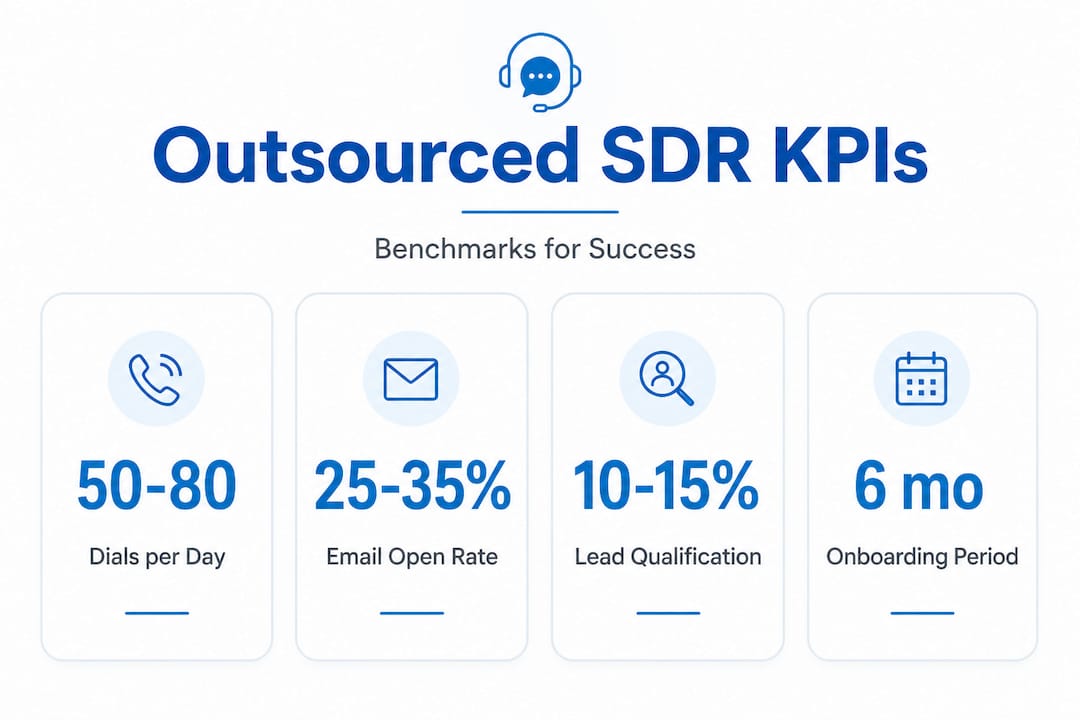
| Expect an onboarding period | Outsourced SDR value is only evident after at least 6 months of careful onboarding, training, and iteration. |
| Leverage AI to boost SDR impact | AI agents streamline prospect research and outreach, improving efficiency for both outsourced and internal SDRs. |
| Prioritize knowledge transfer | Successful outsourcing hinges on deep product knowledge and realistic leadership expectations from the start. |
| Outsourcing isn’t ‘set and forget’ | SDR partnerships require ongoing feedback, oversight, and process improvements to deliver quality meetings. |
Understanding outsourced SDRs and why global teams consider them
An SDR (Sales Development Representative) focuses specifically on the earliest stages of the sales process: identifying potential customers, executing outreach across email, phone, and LinkedIn, qualifying leads against your ideal customer profile (ICP), and booking meetings for your account executives. They do not close deals. They fill the top of your pipeline.
When you outsource that function, a third-party provider supplies trained representatives who execute that same outreach on your behalf. They work from your ICP, your messaging, and your scripts, but they are employed, managed, and trained by the outsourcing partner.
Why multinational companies find this model attractive:
- Entering a new country or language market without building a local team from scratch
- Covering time zones where your internal team has no presence
- Adding prospecting capacity quickly without a lengthy recruitment and training cycle
- Reducing cost per qualified lead, particularly in markets where labor costs are lower
- Testing market demand before committing to a full in-house investment
The core motivation is almost always some combination of speed, scale, and coverage. Outsourced SDR execution often functions as a buffer while internal teams focus on discovery, demos, closing, and exception handling, which is exactly the kind of role separation that prevents your best closers from spending hours on cold email sequences.
One nuance worth understanding is the difference between a fully outsourced model and a hybrid model. In a fully outsourced setup, the external team handles all prospecting. In a hybrid setup, internal SDRs own strategic accounts and complex outreach while the external team handles volume prospecting or covers specific regions. Most multinational companies end up in hybrid territory, which often produces the best outcomes.
If your company also relies on outsourced appointment setting services, the alignment between SDR outreach and meeting scheduling becomes especially important. You can read more about how outsourced appointment setting works as part of a broader pipeline strategy.
“The question is not whether to outsource prospecting, but how to structure the engagement so the external team amplifies your internal strengths rather than duplicating your weaknesses.”
Pro Tip: Before engaging any external SDR provider, map out which pipeline stages your internal team handles best. Outsource the stages where bandwidth is the core bottleneck, not where strategy or product knowledge is most critical.
Pros and cons: Key advantages and hidden risks of outsourcing SDRs
No outsourcing decision is risk-free, and SDR outsourcing is no exception. The smart move is to go in with a clear-eyed view of both sides.
Top three benefits of outsourcing SDRs:
- Speed to market. An experienced outsourcing partner can deploy a trained team in weeks, not months. For a company entering Germany, Poland, or the Netherlands for the first time, this speed advantage is significant.
- Cost efficiency. Building an in-house SDR team involves recruitment costs, salaries, benefits, management overhead, and technology. Outsourced SDR support typically runs at roughly €6 to €8 per hour for well-structured engagements, which makes the economics very attractive for pilot programs or regional expansions.
- Multilingual coverage. Outsourcing gives you access to talent pools with native or near-native proficiency in multiple languages, which is extremely hard to replicate when hiring locally in every target market.
However, the risks are real and often underestimated. External SDRs are not plug-and-play; success depends on product knowledge transfer, training, and realistic evaluation windows. Many companies launch an outsourced SDR engagement and expect results within the first 30 to 60 days, which is rarely achievable given the complexity of B2B prospecting.

| Factor | Outsourced SDR model | In-house SDR model |
|---|---|---|
| Time to deploy | 2 to 6 weeks | 2 to 4 months |
| Cost per month (team of 3) | €4,000 to €8,000 | €15,000 to €25,000+ |
| Language flexibility | High (multilingual teams) | Low (limited by local hires) |
| Product knowledge depth | Moderate (requires training) | High (embedded in company) |
| Scalability | High (add reps quickly) | Low (slow recruitment) |
| Brand alignment risk | Higher | Lower |
Common pitfalls to avoid:
- Handing over a weak ICP and expecting the external team to fix it
- Failing to provide regular feedback on lead and meeting quality
- Measuring only volume metrics (calls made, emails sent) rather than outcome metrics (qualified meetings booked, pipeline generated)
- Skipping knowledge transfer sessions entirely and providing only a one-page product sheet
- Not assigning an internal owner to manage the outsourcing relationship
Avoiding these mistakes is the difference between an outsourcing engagement that builds pipeline and one that burns budget. If you want a broader view of what goes wrong in outsourcing arrangements, our guide on outsourcing mistakes to avoid covers patterns we see consistently across industries.
Pro Tip: Set up a biweekly call review process where your internal sales lead listens to recorded calls from the external SDR team and provides structured feedback on messaging accuracy, tone, and qualification criteria. This one habit prevents months of drift.
For companies thinking about how to build scalable outsourcing infrastructure across multiple functions, our scalable outsourcing guide walks through the architectural decisions that matter most.
How to set your outsourced SDR team up for success
Getting results from an outsourced SDR team is almost entirely a function of how well you design the partnership, especially in the first 90 days. Treat this like onboarding a new internal hire, because the knowledge transfer requirements are very similar.
Step-by-step onboarding and performance framework:
- Define your ICP with precision. Industry, company size, tech stack, geography, decision-maker title, key pain points, and disqualifying factors. The more specific you are, the better your outsourced SDRs can prioritize their time.
- Build your messaging playbook. This includes email sequences, call scripts, LinkedIn connection templates, voicemail scripts, and objection-handling frameworks. Do not assume the external team will figure out the right message on their own.
- Run a structured knowledge transfer week. Have your product or solutions team spend focused time with the external SDRs explaining core use cases, customer success stories, and competitive differentiators.
- Set a 30/60/90 day milestone plan. Week one to four is ramp-up and message testing. Month two is volume with feedback loops. Month three is optimized execution with clear KPI targets.
- Establish feedback loops. Weekly reporting on activity metrics, biweekly call reviews, and monthly pipeline analysis tied to revenue impact.
- Iterate on segmentation and messaging. Do not lock in your initial approach. Treat the first three months as a testing phase where you learn what resonates with each target segment.
Leaders should expect an onboarding period and be ready to iterate on messaging and segmentation rather than prematurely conclude that outsourcing has failed.
This point matters enormously. The companies that write off outsourced SDRs after 45 days typically had internal problems with their messaging or ICP, not an execution problem with their external team.
Technology also plays an increasingly important role. AI agents are expected to cut prospect research time by 34% and email drafting time by 36%, which means your outsourced SDR team’s effectiveness can scale significantly when the right tools are in place. Prioritize providers who already use AI-assisted prospecting and CRM-integrated workflows.
| KPI | What it measures | Healthy benchmark |
|---|---|---|
| Dials per day | Activity level | 50 to 80 |
| Email open rate | Messaging relevance | 30% to 45% |
| Qualified meeting rate | Lead quality | 5% to 10% of outreach |
| Show rate | Meeting quality | 70% or higher |
| Pipeline sourced | Revenue impact | 3x to 5x program cost |
When your outsourcing partner uses CRM-fueled multilingual support workflows, data flows between your systems in real time, which makes performance tracking far more reliable and reduces manual reporting overhead.
When — and when not — to outsource: Decision frameworks for multinational sales leaders
Not every company is ready to outsource SDR functions. The decision depends on where your gaps actually are and whether outsourcing addresses the root cause or just adds complexity.
Strong signals that outsourcing SDRs makes sense:
- Your internal team has enough pipeline to manage but not enough capacity to generate it consistently
- You are entering markets where you have no local language fluency on your team
- You need to test demand in a new vertical or geography before committing to headcount
- Your current cost per qualified meeting is significantly above benchmarks
- Recruiting local SDRs in target markets would take more than three months
Warning signs that outsourcing SDRs will not work right now:
- Your ICP is unclear or changes frequently based on internal disagreements
- Your product or offer requires deep technical knowledge that takes six months or more to learn
- You have no internal owner who can manage the relationship and provide ongoing feedback
- Your brand voice and communication standards are not documented or easily transferable
- Leadership expects results in less than 60 days and is not willing to invest in onboarding
A key consideration for multinational teams is managing hybrid and agentic workflows alongside capacity constraints in prospecting. That means thinking carefully about what the external team owns versus what stays internal, and building handoff processes that do not drop context between teams.
A practical readiness checklist:
- Documented ICP with firmographic and behavioral criteria
- Defined outreach sequence (email, call, LinkedIn) with at least three touchpoints per channel
- Internal champion who owns the vendor relationship
- CRM setup that can track external SDR activity and attribute pipeline
- Realistic performance timeline of at least 90 to 180 days
- Budget allocated for onboarding support, not just the SDR seat cost itself
Pro Tip: Before signing any external SDR contract, run a two-week internal “prospecting sprint” where your team documents every step of their current outreach process. That documentation becomes the foundation of your outsourcing playbook and dramatically accelerates external team ramp-up.
When you are evaluating whether to outsource versus build internally, our analysis of outsourcing vs in-house support provides a structured comparison that applies across multiple business functions, including sales development.
What most leaders miss about outsourcing SDRs
Here is the uncomfortable truth: most underperforming outsourced SDR engagements are not actually caused by the external team. They are caused by internal process failures that outsourcing exposes rather than creates.
When an external SDR team produces low-quality meetings, the instinct is to blame the provider. But outsourcing amplifies existing weaknesses in product and offer messaging and training. If your internal SDRs were also booking meetings with prospects who showed up unprepared or disqualified immediately, the external team will do the same, only at higher volume and with less brand context to compensate.
We have seen this pattern consistently over nearly 20 years of supporting multinational companies with outsourced operations. The companies that succeed with external SDR teams treat the engagement like a mirror. If the external team struggles to explain the product value proposition, that is a signal the ICP is fuzzy or the messaging is unclear, not that the reps are incompetent.
The best outsourcing partnerships we observe share three characteristics. First, there is a dedicated internal owner who invests time in the relationship every single week. Second, the company iterates on messaging based on real call data rather than waiting for quarterly reviews. Third, leadership accepts that the first 60 days are a calibration phase, not a results phase.
The truly counterintuitive insight: companies that over-invest in onboarding their external SDR team almost always outperform companies that spend that energy negotiating lower per-seat pricing. The cost of a well-equipped external rep is far lower than the cost of three months of misaligned outreach that damages your brand in a new market.
If you are exploring how strategic outsourcing supports broader business growth beyond SDR functions, our perspective on administrative services outsourcing covers how the same discipline of process clarity and vendor investment applies across departments.
Partner strategically for global SDR success
Choosing the right outsourcing partner is as important as the decision to outsource in the first place. For multinational companies, that means looking for a provider with multilingual capability, structured onboarding, and proven experience across the industries and regions you are targeting.

At CallTech Outsourcing, we have spent nearly 20 years building multilingual outbound and customer engagement teams for companies across Europe and international markets. Our teams support outbound campaigns, market research, and customer engagement in more than 15 European languages, with transparent pricing, fast onboarding, and CRM-integrated workflows that give you full pipeline visibility from day one. Whether you need coverage in a single new market or a scalable multilingual SDR program across multiple regions, our outsourcing call center services are designed to deploy quickly and perform consistently. Explore how we structure enhanced multilingual engagement for companies ready to grow across borders.
Frequently asked questions
How long does it take for outsourced SDRs to deliver measurable results?
Outsourced SDRs typically require about 6 months for onboarding, training, and initial campaigns before you can accurately measure impact. Outsourcing typically takes at least six months to gauge true value, so plan your evaluation timeline accordingly.
How do AI agents support outsourced SDR operations?
AI tools help outsourced SDRs work faster and more accurately by automating prospect research and email drafting. AI agents are expected to cut prospect research time by 34% and email drafting time by 36%, which meaningfully increases output per rep.
What are the main risks in outsourcing SDR functions?
The biggest risks are poor product knowledge transfer, cultural misalignment with your brand voice, and low meeting quality when onboarding is rushed. Outsourced SDRs may lack deep product knowledge and struggle with brand fit if the partnership is not structured carefully from the start.
How do multinational companies balance internal and outsourced SDR roles?
Most global sales teams use outsourced SDRs to handle prospecting volume and regional coverage, freeing internal staff to focus on demos, discovery, and closing. Outsourced SDR execution functions as a buffer, letting your best closers spend time where their skills have the highest return.
