
Unreliable customer support costs more than most businesses realize. Downtime costs organizations over $300,000 per hour on average, and that number climbs fast when your customers speak different languages and expect help across multiple channels. For companies operating across international markets, the gap between “we have support” and “we have reliable support” is where revenue leaks, trust erodes, and churn accelerates. This guide breaks down what reliability actually means in a multilingual context, how modern technology and human expertise work together to deliver it, and what metrics tell you whether you are truly hitting the mark.
Table of Contents
- Defining reliability in customer support: What really matters
- The mechanics of reliability: AI, human agents, and service management loops
- Multilingual challenges and edge cases: Building true reliability for global teams
- Measuring and benchmarking reliable customer support in 2026
- The uncomfortable truth about reliability: Why ‘set and forget’ doesn’t work
- Enhance your customer support with expert multilingual solutions
- Frequently asked questions
Key Takeaways
| Point | Details |
|---|---|
| Reliability is ongoing | Maintaining reliable support means continually testing, improving, and adapting processes—not just a one-time fix. |
| Multilingual needs add complexity | Serving customers across languages requires extra attention, as AI and agents can struggle with less-common scenarios. |
| Metrics drive improvement | Tracking key metrics like CX scores and response rates helps businesses stay ahead and reliably meet customer needs. |
| AI and human teams must collaborate | Blending automation with skilled human support is essential for handling complex or sensitive issues. |
Defining reliability in customer support: What really matters
Reliability in customer support is not just about picking up the phone. It means delivering fast, accurate, and consistent answers every time a customer reaches out, regardless of the channel they use, the language they speak, or the time zone they are in. For international businesses, this definition carries extra weight.
A customer in Germany expects the same quality of response as a customer in Spain. A user contacting you via live chat deserves the same accuracy as one calling your support line. When either of those expectations breaks down, you lose trust. And trust, once lost, is expensive to rebuild.
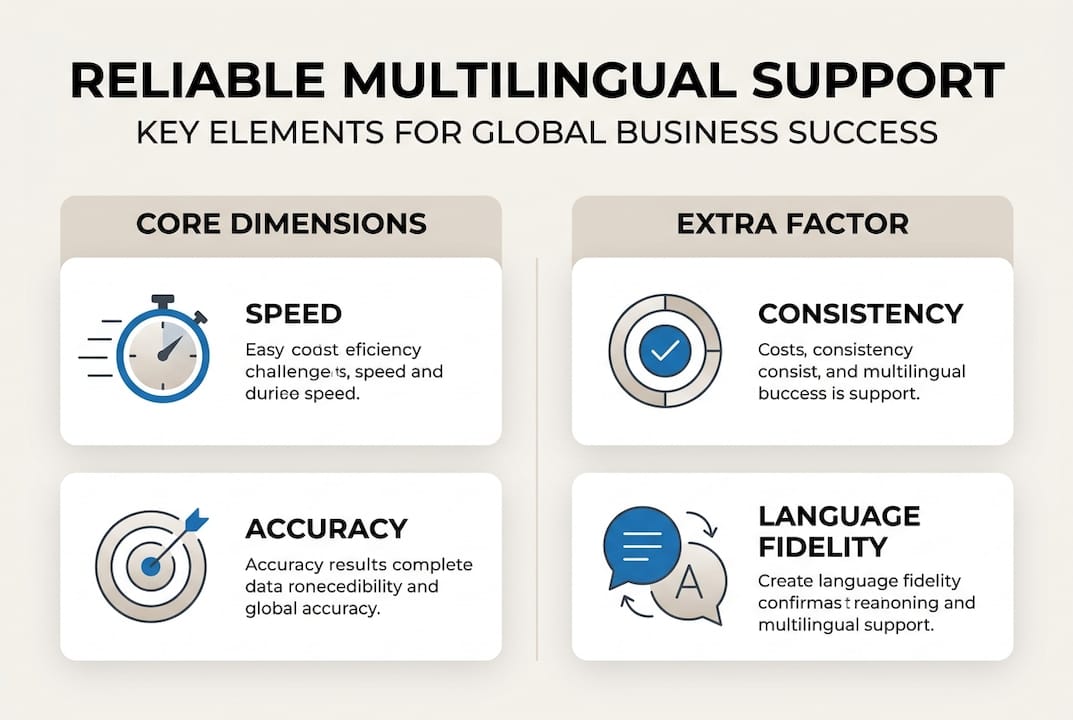
Modern reliability rests on three pillars:
- Speed: First response times that match channel expectations (under 60 seconds for chat, under 4 hours for email)
- Consistency: The same correct answer, regardless of which agent or channel handles the inquiry
- Accuracy: Responses that actually solve the problem, not just acknowledge it
The multilingual call center process adds a fourth dimension: language fidelity. A technically correct answer delivered in broken or culturally inappropriate language still fails the customer.
Here is a quick comparison of classic manual support versus integrated human-AI support:
| Dimension | Manual-only support | Human-AI integrated support |
|---|---|---|
| Response speed | Dependent on agent availability | Instant for routine queries |
| Language coverage | Limited by headcount | Scalable across languages |
| Consistency | Varies by agent | Standardized via AI logic |
| Escalation handling | Ad hoc | Structured and documented |
| Downtime risk | High during peaks | Reduced through automation |
Omnichannel consistency, AI automation, and structured escalation are the mechanics that make modern support reliable. Without all three working together, you are building on sand. Poor data quality in support AI is one of the most common failure points, because an AI trained on incomplete or biased data will produce inconsistent answers at scale.
The bottom line: reliability is not a feature you switch on. It is a standard you maintain through process, technology, and trained people.
The mechanics of reliability: AI, human agents, and service management loops
Knowing what reliability looks like is one thing. Building and sustaining it is another. The companies that get this right operate what we call a service management loop: a continuous cycle of detect, diagnose, route, resolve, and learn.
Here is how that loop works in practice:
- Detect: The system identifies an incoming query and classifies it by type, language, and urgency
- Diagnose: AI checks whether the query matches a known resolution path
- Route: Routine queries go to automated self-service; complex or emotional ones escalate to a human agent
- Resolve: The agent or AI closes the query with a documented outcome
- Learn: Data from the interaction feeds back into the AI model and agent training
AI now automates the majority of routine support interactions, and 90% of organizations report that downtime in this loop carries serious cost. That makes the escalation step critical. When AI fails or misclassifies, a skilled human agent needs to catch it fast.
Here is how AI and human roles divide in a well-run operation:
| Query type | Handled by | Expected resolution time |
|---|---|---|
| Password resets, FAQs | AI / self-service | Under 2 minutes |
| Billing disputes | Human agent (AI-assisted) | Under 15 minutes |
| Technical escalations | Senior agent | Same business day |
| Multilingual edge cases | Specialist agent | Agreed SLA |
The hybrid support approach outperforms both fully automated and fully manual models because it plays to the strengths of each. AI is fast and tireless. Humans are empathetic and adaptable. Together, they cover the full spectrum of customer needs.

Your customer support outsourcing tools also matter here. CRM integration ensures agents have full context before they say hello. VoIP infrastructure keeps call quality consistent across borders. Secure communication systems protect customer data across every interaction.
Pro Tip: Run a quarterly stress test on your entire support stack. Simulate peak volumes, introduce edge-case queries in your least-common supported language, and deliberately trigger escalation paths. If something breaks in testing, it will definitely break in production.
Multilingual challenges and edge cases: Building true reliability for global teams
Here is where many businesses underestimate the complexity. Supporting customers in 10 languages is not the same as supporting them reliably in 10 languages. The gap between those two statements is where global companies most often fail.
The most common friction points include:
- Language drift in AI: Models trained primarily on English degrade in accuracy when handling queries in Polish, Romanian, or Dutch
- Volume spikes: A product launch or service outage can flood your support queue with queries your system was not sized to handle
- Cultural nuance: A phrase that signals frustration in one language may read as neutral in another, causing AI to misclassify urgency
- Unusual query types: Customers ask unexpected questions. When those questions fall outside training data, AI either fails silently or gives a wrong answer confidently
The research is clear on this: multilingual inputs degrade AI performance and can introduce security vulnerabilities, with the severity varying by task type and the proportion of non-primary language in the input. This is not a theoretical risk. It is a documented, measurable problem.
“The assumption that an AI agent performing well in English will perform equally well in other languages is one of the most expensive mistakes a global support team can make.”
Human oversight is not optional in this context. It is the safety net that catches what AI misses. Specialist agents who understand both the language and the cultural context of a query are irreplaceable for quality control and escalation handling.
Strategies that work for optimizing multilingual workflow include routing queries by detected language before they reach an agent pool, maintaining language-specific quality benchmarks, and scheduling regular audits of AI outputs in each supported language.
If you are evaluating outsourcing multilingual support, look for partners who can demonstrate language-specific performance data, not just aggregate satisfaction scores.
Pro Tip: Do not assume your AI performs equally across all supported languages. Pull accuracy reports by language monthly. If one language is consistently underperforming, it needs targeted retraining or additional human coverage.
Measuring and benchmarking reliable customer support in 2026
You cannot improve what you do not measure. And in 2026, the bar for reliable support is higher than it has ever been.
The Forrester CX Index 2025 shows a decline in global reliability metrics across most industries, with only 10 elite brands achieving full reliability at scale. Those top brands grow revenue at twice the rate of their peers. That is not a coincidence.
Key metrics every international support operation should track:
- CX score: Overall customer satisfaction, broken down by language and channel
- First contact resolution (FCR): Percentage of issues resolved without a follow-up
- Average handle time (AHT): Efficiency measure, but should not be optimized at the expense of quality
- Self-service effectiveness: What percentage of customers resolve their own issues without agent involvement
- Cost to serve: Total support cost divided by total interactions, a critical B2B benchmark
Forrester’s B2B benchmarks specifically highlight cost to serve, staff productivity, and self-service effectiveness as the three metrics most predictive of long-term reliability.
Here is a simple benchmarking framework:
| Metric | Entry level | Competitive | Elite |
|---|---|---|---|
| FCR rate | Below 70% | 70-85% | Above 85% |
| Self-service rate | Below 30% | 30-50% | Above 50% |
| CX score | Below 65 | 65-80 | Above 80 |
| Cost per interaction | High variance | Stable | Declining |
Reviewing top call center services can help you understand where the competitive baseline sits. And if you are planning to grow, a scalable outsourcing guide will show you how to build capacity without sacrificing quality.
Set targets, monitor monthly, adjust quarterly, and repeat. Reliability is a moving target, and the companies that benchmark regularly are the ones that stay ahead.
The uncomfortable truth about reliability: Why ‘set and forget’ doesn’t work
After nearly 20 years of working with international businesses on customer support, we have seen the same pattern repeat: a company invests in a new support system, achieves good results in the first quarter, and then slowly watches quality slip as volumes grow, languages expand, and AI models age without retraining.
Reliability is not a destination. It is a practice.
The rushed deployment of AI in customer service often makes service quality worse before it gets better. Forrester’s research confirms this: quality dips are common in the transition period, and companies that treat deployment as the finish line pay for it in churn.
The brands that consistently outperform do not assume their systems are working. They test them. They challenge their AI with unusual queries. They audit language-specific performance. They treat every volume spike as a stress test and every complaint as a data point.
For businesses scaling into new markets, scalable support outsourcing is often the most practical way to maintain reliability without rebuilding internal infrastructure from scratch. The key is choosing partners who share your commitment to ongoing improvement, not just initial setup.
Enhance your customer support with expert multilingual solutions
Building reliable multilingual support across international markets is not a one-time project. It requires the right infrastructure, the right people, and a partner who understands both the technology and the human side of customer experience.

At CallTech Outsourcing, we have spent nearly 20 years helping companies across Europe, the US, and the UAE deliver consistent, high-quality support in more than 15 languages. From CRM integration and VoIP infrastructure to specialist agent teams, our outsourcing call center services are built to scale with your business. If you are ready to close the gap between “we have support” and “we have reliable support,” explore how we optimize multilingual workflow for global teams just like yours.
Frequently asked questions
What makes customer support ‘reliable’ in 2026?
Modern reliable support combines fast, accurate responses across all channels, minimizes downtime, and adapts to customer needs in any language. It requires omnichannel consistency, structured escalation, and ongoing process improvement.
How can AI improve multilingual customer support reliability?
AI handles routine queries instantly and routes complex issues to skilled human agents, improving speed and consistency. However, multilingual inputs can degrade AI accuracy and introduce security risks, so regular boundary testing is essential.
Which metrics should we track to measure reliable support?
Track CX scores, first contact resolution, self-service effectiveness, and cost to serve. The Forrester CX Index 2025 provides industry benchmarks to evaluate your performance against top-performing brands.
What is the biggest risk to reliability when scaling support internationally?
AI and automated systems can degrade under unusual behaviors or in less common languages, producing incorrect or inconsistent responses. Ongoing testing and trained human backup are the most effective safeguards against this risk.
